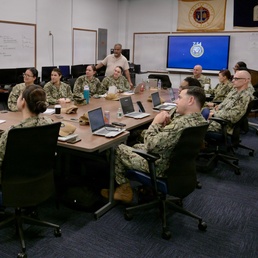
By: Jessica Nilsson, Center for Service Support Public Affairs Officer
NEWPORT, R.I. - At the Center for Service Support (CSS), training never stands still — and neither do the Sailors responsible for shaping the Navy’s future force. From May 12-20, 2026, subject matter experts (SMEs) from across the Fleet gathered at the Navy Chaplaincy School in Newport, Rhode Island, for two intensive Personnel Qualification Standards (PQS) and training manual workshops focused on strengthening fleet-wide professional standards for the Navy Counselor (NC) and Mass Communication Specialist (MC) ratings. The workshops brought together senior enlisted leaders, officers, and Fleet experts to review, revise, and modernize critical qualification tools that help Sailors succeed in some of the Navy’s most people-centered and mission-focused careers. For the MC community, participants updated the Mass Communication Specialist PQS, Navy Aircrew Aerial Cameraman PQS, and Visual Information Personnel (VIPER) Team PQS. Navy Counselors focused on revisions to the Navy Counselor Supervisory Training Manual, NC Immediate Supervisor in Charge (ISIC) PQS, and Command Career Counselor PQS. A PQS serves as the Navy’s qualification system for officers, enlisted personnel, and government civilians when certification of a minimum level of competency is required before performing specific duties. The ultimate goal is to produce functional, competent watch standers while expanding Sailors’ technical knowledge and operational readiness. But for the Sailors attending these workshops, the mission went beyond editing documents. Participants were challenged to build standards that reflected today’s operational environment while remaining practical, executable, and uncompromising in quality. For many attendees, collaboration became one of the most rewarding aspects of the process. “My favorite part of the PQS was the group collaboration of each line item,” said Navy Counselor Senior Chief Kelli John. “Everyone contributed to provide a great product. It was amazing to be part of this working group, update information, and assist in standardizing our training for NC ISICs.” NCCS John highlighted Section 102 of the revised PQS, Conducting a Career Information Program Review (CIPR), as especially impactful because it reinforces standardized training practices and ensures counselors remain aligned on critical timelines, grading criteria, and career development processes. The NC workshop also reinforced the vital role counselors play in maintaining Navy readiness and retention. “NCs help shape the future force by becoming subject matter experts, informing Sailors of available resources and where to find them, and effectively managing our Career Development Program,” NCCS John explained. “We have direct involvement in every Naval community and must be well versed, so Sailors make informed decisions.” That responsibility resonated throughout the workshop as participants examined how updated training directly impacts the fleet. “My proudest accomplishment during this course is knowing that the updates to the Navy Counselor PQS, ISIC PQS, and Supervisory Training will directly develop excellent Career Counselors,” said NCC Xavier Tirciovera. “When we ensure our Sailors receive the absolute best career guidance, we are helping them focus on their mission, making our Navy a more effective and lethal fighting force.” For NC1 Jessica Hunt, the workshop reinforced how leadership and mentorship influence operational effectiveness across the fleet. “One takeaway I will carry throughout my career is that our combat lethality is directly tied to how well we develop and pour into our Sailors,” Hunt said. “When a Sailor feels heard, mentored, and sees a clear path forward, their commitment to the mission becomes unshakable.” Hunt added that revising the Command Career Counselor PQS, ISIC PQS, and Supervisory Training Manual helped shift her perspective from individual counseling to strategic fleet-wide leadership. “Helping one Sailor is a good start, but using these three tools together allows counselors to safeguard the career trajectories of thousands,” she said. Meanwhile, the MC workshop focused on the evolving demands placed on communicators responsible for telling the Navy story around the globe. From documenting operations to supporting strategic communication efforts, MCs often work at the intersection of operational security, public trust, and real-time decision making. “Behind every deployment and operation are the Sailors and Marines who execute their mission far from home, and the families eagerly awaiting their return,” said Mass Communication Specialist Chief Evan Thompson. “Effective storytelling is our way of highlighting the vital work they do every day and bridging the distance between the deckplates and the homefront.” MCC Thompson noted that the public often sees only the finished products — photographs, videos, articles, and social media posts — without recognizing the complexity behind the scenes. “People see the final product and think the job is light, but they don’t see the immense pressure of operating in the grey zone,” he said. “MCs often have to make split-second judgment calls where a single image or sentence can carry massive strategic consequences.” Participants in both workshops represented commands from across the fleet, bringing operational experience from aviation, submarines, surface forces, training commands, public affairs offices, and fleet staffs. Their collective expertise ensured the revised standards reflect real-world fleet requirements and evolving mission demands. Once finalized, the revised training manuals will be updated and posted to the CSS NRTC application for course completion, while updated PQSs will be made available for download through MyNavy Portal. By bringing together experts from across the Navy enterprise, the Center for Service Support continues to strengthen the foundation of fleet readiness — ensuring Sailors not only meet qualification standards, but are prepared to lead, communicate, mentor, and fight effectively in tomorrow’s Navy.