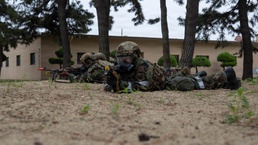
KUNSAN AIR BASE, Republic of Korea -- The Wolf Pack conducted the latest iteration of its readiness exercises, Beverly Sentinel 26-3, at Kunsan Air Base, Republic of Korea, May 18-20, 2026.
Bev. Sent. 26-3 challenged Airmen to execute mission-critical decisions under intense circumstances while maintaining the tempo required to defend the base and sustain combat operations.
Exercise scenarios emphasized adaptability, rapid response, and clear communication as key components of mission success, ensuring personnel remained prepared to survive, operate, and prevail in contested environments.
“Ability to Survive and Operate exercises give us the opportunity to rehearse skills that we don’t get to practice during our day-to-day duties,” said U.S. Air Force Col. Valerie “Hawk” O'Brien, 8th Medical Group commander. “Having the basic maneuvers be second nature so leaders and Airmen can focus on solving more complex situations that may arise is critical to mission success.”
Each Wolf Pack unit, including communications, civil engineering, security forces, finance, and more, strengthened mission-essential skills while refining life-saving techniques and strategies such as Tactical Combat Casualty Care and emergency response procedures to maintain operational readiness.
“It is important to train how you fight,” said U.S. Senior Airman Dorian Cain, 8th Force Support Squadron readiness and plans technician. “I don’t believe we should just wait until we get attacked then start planning. We are doing it the right way; learning enemy capabilities and strategizing through scenarios on how to adapt to their tactics.”
Cain explained that his unit was successful in taking charge during a simulated opposing force scenario by using weapons training and rehearsed tactical fundamentals, including shoot, move, and communicate techniques for close-quarters battle scenarios. By the time security forces arrived, his unit had already successfully taken back complete control of the facility.
Routine ATSO exercises provide integrated training designed to test coordination, decision-making, and operational effectiveness during prolonged crises and sustained stress scenarios.
“Exercises showcase our resolve and resilience to our allies and adversaries alike,” said O'Brien. “This increases the confidence of our allies and makes our adversaries take note and question their own desire to engage in combat with us. Deterrence defined!”