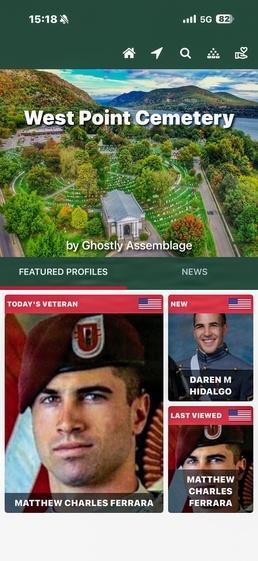
Memorial Day is a solemn reminder of the U.S. service members who gave their lives in service to the Nation and a time to honor their ultimate sacrifice. However, remembrance extends beyond Memorial Day. For those interested in attending the West Point Cemetery at any point in the year to pay respects to a family member, friend or historical figure, there is now an easier way to locate those buried there and reflect on their lives and service.
Officially released in August 2025, the West Point Cemetery App allows visitors to the cemetery to find gravesites with pinpoint accuracy. As the architect behind it all, U.S. Military Academy Class of 1970 graduate Bill Taylor, said, “There is a life story to be told behind every gravestone,” which the app presents with videos, photos and profiles highlighting some of the cemetery’s more than 10,700 occupants.
The evolution of the app began with a project called Virtual West Point, with the purpose of bringing the West Point experience to life through the internet. Taylor stated Virtual West Point livestreamed graduations, graduation parades, Founder’s Day banquets for about five years beginning in 2001.
The original plan, long before the word ‘app’ became part of the everyday lexicon, was to provide computer access to the cemetery database.
“The intent was to essentially sit at your computer where you could look up a name, and when you clicked on the name, you would see a picture of the headstone and a location of where the person was in the cemetery,” Taylor explained. “Then once you click on the headstone picture, you walk through that person’s life – that was the idea, but it never happened.”
Taylor received help from a former West Point company mate, USMA Class of 1967 graduate Freed Lowrey, a cemetery expert who recorded a 47-minute walking cemetery tour video in 2001 The video remains available on YouTube today, despite being filmed years before the platform existed.
Although they raised enough money to acquire equipment and maintain operations, operating costs eventually became too high due to the expense of hosting streaming video at the time.
“We’re not talking streaming videos like today,” Taylor indicated. “We’re talking about dial-up, we actually had dial-up connections then.”
In 2021, Taylor was speaking with Lowrey about an unrelated topic when he reflected on one lingering disappointment from Virtual West Point.
“Freed, my only lament is that we were never successful in doing anything with the cemetery for Virtual West Point,” Taylor recalled saying.
Lowrey responded, “Funny, you mention that because I’ve been working with some guys from New Zealand on a project called ‘Hallowed History.”
Taylor said Lowrey had already been collaborating on the more expansive cemetery-focused project for nearly three years.
This larger project focuses on documenting all military cemeteries in the United States, Canada, United Kingdom, Australia and New Zealand. Taylor immediately contacted Scott McJorrow and Mike Reid with Hallowed History New Zealand and has continued conversations with them every other week for the past five years.
Taylor described the effort as a “labor of love,” noting that it is not currently a revenue-generating venture.
There are two parts to the business – a non-profit part, which is focused on military cemeteries, and the aspirations for a for-profit part supporting commercial cemeteries.
The basic concept of the venture is to offer an app which has a database of people buried in a cemetery, geolocation of where those gravesites are located, and the ability to look up a name to find the gravesite.
“If you’re in the cemetery, you can click on the ‘Go’ button to the gravesite, and it will draw you a line from where you are, how to get there, and then as you walk there, it moves with you until you’re right on top of it,” Taylor said. “Those were the basic elements that we started with, and there were lots of challenges because of geolocation and time difference between us and New Zealand.”
The breakthrough came in 2023, when Taylor volunteered to set up a U.S. form of the business, “Hallowed History USA,” to help with raising money. He also formed a collaboration with Ghostly Assemblage Inc., a life-story website and system officially approved for use at West Point Cemetery that played an integral role in the initial development and release of the cemetery app. Taylor now oversees the site and incorporated it as part of the process to obtain 501(c)(3) nonprofit status.
In July 2024, working with the West Point Association of Graduates President Mark Bieger and West Point Chief of Staff Col. Khanh Diep, the Directorate of Academy Advancement granted the approval of the non-profit entity to “support veterans and inspire children by bringing the stories of heroes in our cemeteries to life.”
“We wanted to focus on something where we could make an immediate impact,” Taylor stated. “One of the very unique elements of what Hallowed History does is … tells the story of the person’s life. There’s a photo section, a video section, and the video section is customed-crafted videos that highlight the individual’s life. They are about three-to-four-minute videos.”
Currently, Hallowed History New Zealand has completed eight videos with the help of families, which are now available on the app of those buried at West Point.
The hope is to keep it growing not only for the purpose of those who visit the cemetery, but to help in telling the stories of those buried there to cadets and be a part of the Inspiration to Serve program that takes place each April before cadets affirm their final two years at the academy.
One of the first videos displayed when the app came out was of USMA Class of 1995 graduate Jimmy Adamouski, who was Taylor’s oldest son’s classmate.
“Jimmy was the first West Point grad killed in Operation Iraqi Freedom,” Taylor acknowledged. “He was a Black Hawk pilot who went down and crashed. I went ahead and worked with the family and got the video done, and then we added three others later in 2025. Those videos have had a huge impact; however, out of 10,700-plus people buried in the cemetery, we only have the eight videos.”
Taylor is working with the Simon Center for the Professional Military Ethic, which also hosts the Inspiration to Serve event, to connect with families of the fallen and continue expanding the app’s collection of life-story videos.
Future plans for the project include developing computer and tablet versions of the app in addition to the existing mobile platform. Plans also include allowing users to access the database and contribute additional historical information and content.
“This is how the database will grow, but it all has to be vetted,” Taylor explained. “Families will be a key part of what is acceptable to put in. We haven’t established all the rules yet, but that will follow shortly.
“I think we’re within a week or two of having a demonstration,” he added. “The web-based version of the app will be done within a month, but we’re not going to release it until we’ve secured funding to compensate the people who developed it.”
Taylor noted that some contributors have worked on versions of the project for nearly a decade, including early beta versions in New Zealand dating back to 2016, without compensation.
“We have a great app, we have the skeleton of a database,” Taylor said.
When the app premiered last July, its GPS technology could guide visitors to within approximately one meter of a gravesite. Taylor said the system has since improved to less than a centimeter of accuracy.
To improve connectivity throughout the cemetery, Taylor also provided a Starlink antenna for the grounds. Plans are already underway to add a second antenna to expand coverage to areas not fully reached by the original system.
Taylor’s connection with the cemetery began as a Plebe in January 1967 when he attended the funeral service of 1952 USMA graduate and NASA astronaut, Ed White, who was killed in the Apollo I fire.
Within the cemetery, stories such as that of U.S. Military Academy Class of 2005 graduate Matthew Ferrara, who was killed in Afghanistan in 2007, are among those Taylor hopes to continue adding to the database.
“There are hundreds of stories, but not thousands like we want and need,” Taylor mentioned. “In general, it’s hugely important to honor our ancestors.”
Even the inspiration behind Virtual West Point traces back to Dave Hughes, a U.S. Military Academy Class of 1950 graduate who pioneered distance learning in 1982 by using computer networks to teach high school students concepts related to chaos theory in mathematics.
“He became my mentor … and we had done a study around 1995 about public awareness of West Point,” Taylor said. “I lamented the fact that there wasn’t more public awareness of West Point, other than the Army-Navy Game – although some of them think its Army guys playing and not U.S. Military Academy cadets.
“So, Hughes’ response to that was, if you want to increase public awareness at West Point, create a virtual West Point on the internet,” he added. “This was the seed of the idea, and he donated the first $10,000 when I set it up as a a 501(c)(3) non-profit to get the thing kicked off, so he was a clear inspiration for me.”
Hughes, besides being a Korean War hero, was one of the pioneers of wireless communications and helped Wales become the first area in England to receive online communications in the ‘90s, years before broader expansion efforts were expected.
“He was that kind of guy, and I was the primary mover to get him the Distinguished Graduate Award in 2004,” Taylor stated. “Having the Distinguished Graduate ceremony, it reminded me of a quote from one of his students who said, ‘Lots of people have left footprints in the past. Dave Hughes left footprints in the future.’”
Taylor said he wants this app to leave footprints in the future for those to reflect on the past with technology as the pathway.
“It’s very exciting to me, but if I want to leave a legacy behind, it’s a legacy of empowering people to share more information,” Taylor mentioned.
The West Point Cemetery App is available on Apple and Google Play marketplaces, and Taylor’s hope is that more people use and experience the possibilities of the new app.
“I just would like more people to download the free app and take advantage of what’s there,” he concluded. “And for others to contribute if you have family buried in the cemetery – to help us tell their story.”