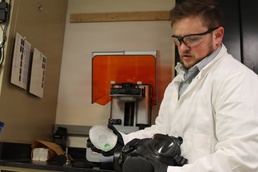
Aberdeen Proving Ground, MD — Protective masks could see a colorful upgrade with technology that would visibly change colors when airborne hazards are detected. Engineers and scientists at the U.S. Army Combat Capabilities Development Command Chemical Biological Center (DEVCOM CBC) are working on an innovative filter to allow respirators to detect airborne chemical and biological threats.
The Passive Collection of Hazards from Air onto Networks Towards Operational Monitoring sampler, or PHANTOM, is designed to attach directly to the standard-issue M50 respirator. It integrates seamlessly with the mask's existing components, and is a major improvement over older, bulky hazard sensors. PHANTOM requires no batteries and the overall design does not adversely affect airflow or impact the respirator’s protective capabilities. Rather, it adds a detection/sampling capability to a piece of equipment already in use by the warfighter.
By seamlessly adding this capability to the M50, PHANTOM can reduce the burden to the warfighter. “We think of sampling an environment as an active task for specific teams to accomplish,” said Dr. Kristian Van de Voorde, a chemical engineer at DEVCOM CBC. “What if we could eliminate this active task, and make sampling the environment a passive operation that is integrated into any mission set from any person wearing a respirator?”
The development of the PHANTOM sampler was propelled by the Quick Empowerment Leads to Successful Tomorrows (QUEST) initiative, the Center’s premier seedling grant program. In March 2025, Van de Voorde was one of twelve project leads selected to receive proof-of-concept funding after a rigorous pitch to the QUEST panelists.
When the sampler is integrated on the respirator, the warfighter executes their mission as normal while PHANTOM traps potentially hazardous airborne threats. After the operation, the sampler is removed and rinsed into a liquid solution which can be analyzed to determine the specific agent or agents to which the device was exposed. The removal of the sampler does not impact the overall protection to the warfighter
The future of the device includes the development of an insert that changes colors depending on exposure to specific chemical and biological threats, providing a visible indicator. While additional field sampling may be needed for confirmation, the PHANTOM could provide small unit leaders with critical insight to dangers in the field.
The PHANTOM’s complex internal geometries and colorimetric response required strategic academic partnerships with the University of Delaware and Norwich University. While university partners provide deep research potential to explore broader use cases, organizations like DEVCOM CBC can remain laser-focused on delivering practical, end-user solutions to the warfighter.
"On the government side, we have to be deliberate about what we pursue. We have finite testing capabilities, so if a specific geometry isn't going to directly help the warfighter, we don't pursue it," Van de Voorde said. "Our university partners, however, have the bandwidth to look at the entire swath of possibilities."
The collaborative effort has already achieved significant intellectual property milestones; recently, an invention disclosure was filed with the University of Delaware. This formal step not only protects the technology but also paves the way for future engagement with industrial partners to scale the PHANTOM sampler for broader military and commercial use.
Van de Voorde said the sampler could immediately impact warfighters and first responders. “It’s respiratory protection—think about the different environments that first responders [and] firefighters have to go through.” Noting that additional time spent in dangerous environments increases risk, he added, "Maybe they can get enough information from this that they won’t have to do a secondary sweep.”
While the proof-of-concept has been highly successful, the PHANTOM sampler is still actively undergoing refinement. Currently, DEVCOM CBC engineers and their academic partners are rigorously testing and optimizing the 3D-printed matrices. Their goal is to enhance the device's colorimetric capabilities and expand the spectrum of environmental hazards it can seamlessly detect. “Since we are currently using a 3D printer to manufacture these prototypes, we are excited at the potential of a PHANTOM sampler being one of the technologies that could be manufactured anywhere, included in the field,” Van de Voorde said.
The PHANTOM sampler can provide chemical and biological threat information to both the warfighter on the battlefield and domestic teams operating in unpredictable environments. The ongoing development of the system underscores the Center’s commitment to collaborate with partners in academia and industry, collectively working to enhance the protection of the warfighter.