By Bernard S. Little Walter Reed National Military Medical Center Hospital Communications
Skin cancer is largely preventable if people take proper measures to do so, said speakers during the John P. Murtha Cancer Center’s (MCC) annual skin cancer summit held recently at Walter Reed National Military Medical Center.
Military members are more prone to the disease, which can impact readiness and fighting strength, they added.
Despite skin cancer’s risks, by reducing exposure to the sun’s ultraviolet (UV) rays, applying broad-spectrum sunscreen, wearing protective clothing, seeking shade during peak hours and avoiding indoor tanning, people can decrease their chances for developing the disease that impacts about one in five Americans by age 70.
High UV exposure and reflective environments during outdoor missions can increase skin cancer risks for military members, explained healthcare providers at the summit. This poses a significant readiness challenge, as medical treatments can mean absences from duty impacting overall operational effectiveness.
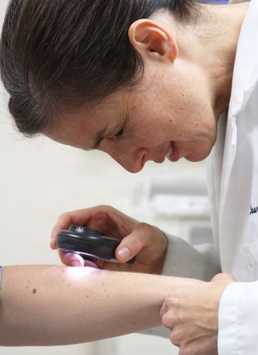
The MCC has hosted the annual summit for more than a decade, followed by screenings in the hospital's dermatology clinic to raise awareness of the dangers of high UV levels, promote early detection, and share advancements in diagnosis and treatment, explained U.S. Navy Lt. (Dr.) Sama Alazawi, an event coordinator.
“Non-melanoma skin cancer is the second most common cancer in service members, second only to melanoma, which is why this year’s summit, as in years past, focused on the epidemiology, diagnosis, risk factors, prevention and treatment of melanoma and other skin cancers,” Alazawi shared.
She explained that most skin cancers treated at Walter Reed affect retirees with cumulative years of sun damage, but melanoma and other skin cancers are increasingly being diagnosed within the young active-duty population.
Overall, more than 5.4 million cases of nonmelanoma skin cancer (basal and squamous cell) are treated in over 3.3 million people annually, according to the American Cancer Society.
“The good news is there have been great advancements in treatment over the past decade or so,” Alazawi added.
“Precision matters more than extent and evidence,” said U.S. Navy Cmdr. (Dr.) Michelle Gage, chief of surgical oncology at Walter Reed in discussing “where we are today” concerning melanoma surgery.
Gage explained that modern melanoma treatments use systemic therapy combinations, and pre-surgical medications now can shrink tumors and reduce procedure extent, offering a more nuanced approach than traditional surgical methods.
“Trajectory has been clear, from anatomical radicalism to biologically informed, evidence-based precision, and more personalized,” she added. “Surgery is still the primary curative modality for localized disease, [with] less aggressive surgery [resulting in] same or better outcomes.”
Dr. Benjamin Kelly, director of Mohs Surgery and Cutaneous Oncology, Scripps Health Center in San Diego, California, agreed. He discussed Mohs surgery for adnexal tumors and cutaneous sarcomas, explaining that it is “a precise, highly effective outpatient technique used for removing thin layers of cancerous tissue, mapping them, and examining them under a microscope immediately, ensuring the margins are clear of cancer while maximizing the preservation of healthy skin.”
Kelly added that he and other providers who specialize in dermatopathology (some practicing at Walter Reed) can analyze tissues at a molecular level to determine DNA changes, tailoring personalized treatments for patients based on genetic makeup. “It’s a pretty neat thing that somebody can come in with a skin cancer and within a matter of a few hours, we can actually cure that cancer and send them home. So that’s rewarding.”
Dr. Melodi Whitley, director of Transplant Dermatology at Duke University, covered the latest updates of skin cancer in transplant patients. She explained that patients who have had organ transplants often develop skin problems including rashes, infections, and sometimes skin cancer, primarily due to immunosuppressive medications they must take to prevent organ rejection. She focuses on taking care of these patients following their transplants to prevent skin cancer or catch them early to avoid the morbidity and mortality associated with later stage skin cancer.
According to the National Institutes of Health, “Organ transplant recipients face a significantly higher risk of developing skin cancer (up to 100 times more likely), particularly squamous cell carcinoma, because necessary immunosuppressant medications can weaken the body's ability to fight off UV-induced DNA damage and viral infections. Prevention means aggressive UV protection including daily SPF 50+ sunscreen, protective clothing, and regular, life-long screenings with a dermatologist.”
“We should also regularly check our skin for changes in moles, new growths and a sore that doesn’t seem to want to heal,” stated Alazawi. While highly curable if caught early, five or more sunburns double the risk for melanoma, according to skin cancer experts.
The Department of War (DOW) began tracking cancer within service members and veterans in1986 when it established the Automated Central Tumor Registry (ACTUR). However, cancer was more significantly recognized as a major readiness challenge with funding and research made priorities in 1992, when Congress created the Congressionally Directed Medical Research Programs.
DOW established the MCC in 2012 when it merged the three military treatment facilities in the National Capital Region: National Naval Medical Center, Walter Reed Army Medical Center, and Malcolm Grow Medical Center, creating DOW’s only Cancer Center of Excellence to protect and sustain military readiness. Recent studies, including a 2023 Pentagon-led study of one million service members, recognize that aircrew and ground crews have higher cancer rates, deeming cancer as a critical, ongoing threat to operational readiness.
To learn more about the MCC, go to https://walterreed.tricare.mil/MurthaCancerCenter.