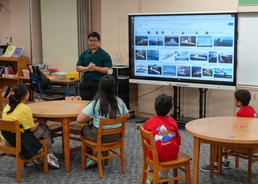
ZUSHI, Japan – Students at Ikego Elementary School experienced hands-on learning in science, technology, engineering, arts, and mathematics during the school's STEAM Day on May 15, bolstered by interactive demonstrations from U.S. Naval Ship Repair Facility and Japan Regional Maintenance Center (SRF-JRMC) personnel and other Yokosuka-based U.S. Navy commands.
Cmdr. David Reinhardt, the Waterfront Operations Officer for SRF-JRMC, delivered the opening remarks to the student body during the school’s morning announcements. To illustrate STEAM concepts in action, Reinhardt pointed to the Artemis II lunar mission.
He broke down the mission for the students, explaining how scientists study the moon to plan the mission, while technology such as the Orion spacecraft keeps astronauts safe. He noted that engineers built the world’s most powerful rocket, art is used to capture photos that show the beauty of space, and math is used to calculate flight paths to ensure a safe return.
Reinhardt reminded the students that by participating in STEAM Day, they were practicing the exact same skills as the Artemis II team.
"You are the next generation of explorers, scientists and engineers," Reinhardt said, setting an inspiring tone for the day.
Following the morning announcements, students rotated through a variety of practical exhibits that translated complex engineering principles into accessible lessons.
U.S. Naval Ship Repair Facility and Japan Regional Maintenance Center personnel led three of the day's core technical challenges. In a lesson on structural analysis, Daniel Lum, the command’s quality assurance director, challenged students to build multi-level, earthquake-resistant structures using straws and connectors. Lum drew connections to local architecture, using Tokyo Tower as an example of how interlocking triangles provide structural integrity.
"I feel fortunate to have supported STEAM days and taught engineering at the University of Hawaii," Lum said. "I’ve seen firsthand how these initiatives can help a young person discover a lifelong interest in science and engineering."
Ryan Garrison, from SRF-JRMC’s Code 710, taught a lesson on hydraulics using syringes filled with water. The students learned that pressurizing water within the syringes created a force proportional to the syringe's size. They also learned to manipulate two hydraulic, syringe-powered robot arms to show how multiple cylinders could move a complex machine. They challenged themselves to pick up tennis balls and drop them in cups. The highlight of the lesson was when the students used two syringes to build a hydraulic press to crush cheese snacks.
The educational demonstrations extended beyond the classroom. Nathan Hall, from SRF-JRMC’s Lifting & Handling Department’s Operations Division, teamed up with a Naval Facilities Engineering Systems Command Far East (NAVFAC-FE) crane crew to teach the fundamentals of heavy equipment operation. Students donned personal protective equipment and learned the specific hand and arm signals required to safely direct a crane operator.
"It was pretty rewarding during the mobile crane demonstration when the kids started shouting out 'hydraulics' as their teacher tried to corral them to sit down for the presentation to start," Garrison said.
The event featured presentations from across the military community. The Ikego Federal Fire Department demonstrated the use of simple machines in rescue operations, along with a hands-on demonstration of its search camera, which uses forward-looking infrared technology to locate victims. The Kinnick High School Robotics Club showcased its REV robot, allowing students to control it to pick up small balls and throw them. REV also used sensors to autonomously navigate to balls of specific colors, catch them, and throw them toward their intended targets.
The participation of SRF-JRMC volunteers highlights the educational impact of the event and the importance of community engagement in inspiring the next generation of engineers and scientists.
For over 75 years, SRF-JRMC has been the linchpin of U.S. naval operations in the Indo-Asia-Pacific region by providing intermediate-level and depot-level repair for the ships of the U.S. Navy and the U.S. Seventh Fleet.