SEOUL, South Korea— A delegation of 25 senior leaders from the Australian War College recently concluded a comprehensive study tour of the Republic of Korea (ROK), focusing on regional security dynamics and the enduring legacy of the Australian-Korean partnership.
Hosted by the Australian Embassy in Seoul, the visit provided members of the Defence and Strategic Studies Course with a deep dive into the complexities of the Peninsula’s security environment and the broader Indo-Pacific. Course members were also exposed to Korea’s post-war economic success and engaged in an exchange with the Korean National Defense College.
The delegation began by visiting the site of the Battle of Kapyong in Gapyeong, a location deeply etched in Australian military history, before proceeding to the Joint Security Area (JSA) to observe the realities of the Demilitarized Zone.
The tour then moved to USAG Humphreys, where the focus shifted to the modern operational environment and the critical role of the U.S. Army Tri-Command, the United Nations Command (UNC), and the UNC Military Armistice Commission (UNCMAC) responsible for enforcing the 1953 Armistice Agreement.
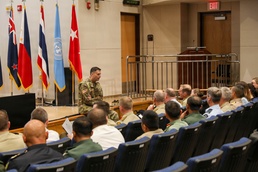
During the visit, UNC Chief of Staff U.S. Army Major General David Womack briefed the delegation on the "many flags" philosophy, highlighting the vital role of UNC-Rear in Japan and the necessity of a united front.
"The ROK is welcoming and thankful for all multinational forces on the Peninsula,” MG Womack emphasized.
"UNC multilateralism elevates interoperability, adds strategic depth and strengthens deterrence.”
Reflecting on the mission, the Australian War College Head of Delegation, Colonel Adam McGuinness, noted that a highlight of the program is the invaluable opportunity afforded course members to visit the countries of regional allies and partners.
“This experiential learning provided an up-close perspective of the regional security environment and the broader security challenge across the Indo-Pacific region.”