MISAWA AIR BASE, Japan – Beside them, the dark Pacific Ocean crashed against the shoreline in white-capped waves that hurled icy salt spray through the air. A freezing wind cut across the beach, burning their faces.
Three people lifted their heavy knees and hauled bumbling lines of buoys across the beach. The wake of displaced sand dragged on as far as their squinting eyes could see behind them, the foggy shadow of their cars parked in a grassy alcove just ahead.
“I kept telling myself I just had to put one foot in front of the other,” said U.S. Air Force Staff Sgt. Stephen Terrick, 13th Fighter Generation Squadron maintenance manager. “It’s cold, there’s snow on the ground and the wind is kicking up because you’re right on the shore.”
He inhaled the stinging air and forced another booted step forward. Pulling the buoys felt like a merciless tug-of-war, each stride dragging through the sand as though he were wading through mud. His boots struggled for traction while his calves burned and shoulders ached.
His gloved fingers ached from holding ocean-weathered rope. Layers of winter clothes did little to protect his tall frame from the whipping wind, yet sweat still soaked through the beanie capping Terrick’s dark hair.
“It was hard and tiring,” he said. “When we first started and there were only three of us, it would take hours going back-and-forth.”
Senior Airman Alberto Rodriguez, former 35th Maintenance Squadron aircrew egress systems journeyman, and his spouse, Tiffany Palumbo, both co-founders of the Umigomi Enrichment Project, trudged beside him on the beach.
The only thing to keep their minds off the tenuous fight against wind and buoys was conversation. It flowed despite the roar of the wind.
“As we walked the beach with Terrick, we shared stories about animals we’d seen injured or killed by litter—birds tangled in fishing line, sea turtles trapped in ghost nets, things that stay with you long after you see them,” Rodriguez said. “Those conversations could have felt overwhelming, but instead they became motivating.”
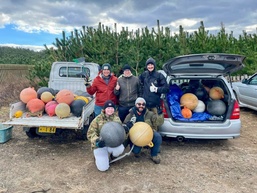
By the end of the day, Rodriguez’s K-truck overflowed with colorful buoys while Terrick’s sedan trunk sat propped open, waiting to be filled. Together, they dragged the floats up the sandy slope towards the vehicles.
Terrick rolled the rope around his wrist for leverage and hefted the gaggle of heavy plastic floats up and into his car. Sand scattered across the dark interior.
He stepped back and gratefully took off his gloves and flexed his fingers in the cold as Rodriguez and his spouse worked together to load the rest of their haul.
His once-empty trunk became full of sea-salted buoys.
“It was really nice to see,” he recalled. “I always feel pride in myself when I go and do something difficult.”
Then came the trip back to base.
Terrick carried the buoys up nine floors to his apartment, taking multiple elevator trips before eventually filling his balcony with plastic floats that had been hosed off and cleaned.
At one point, the elevator stopped on another floor, but another resident could not get inside because the elevator was packed wall-to-wall with buoys.
For Terrick, the overflowing elevator became one of the first signs that the idea Rodriguez and his spouse brought from their zoo background was growing larger than any of them expected. Before becoming a military family and moving to Misawa, the two worked at zoos in the United States. One look at the buoy-laden vacant beaches of Japan sparked an idea, they said.
“We were surrounded by these discarded buoys, and I realized they could have a second life as enrichment items for animals,” Rodriguez said. “It felt like the perfect intersection of my old career and my new one, combining conservation, animal welfare, and service in a way that connected both of my lifelong dreams.”
Terrick quickly offered his support after hearing the idea. He described Rodriguez and his spouse as selfless, caring and hardworking.
“They went by themselves mostly,” he said. “But they invited me out once, and after that I joined their beach cleanups as much as possible.”
Months later, in March 2025, Rodriguez departed for Whiteman Air Force Base with his spouse, leaving Terrick to continue the work on his own.
The cleanup efforts did not stop.
“When my spouse and I moved away from Misawa, we honestly weren’t sure how we were going to keep the project going from a distance,” Rodriguez said. “Without any prompting from us, Terrick stepped in on his own and started organizing cleanups and helping coordinate shipments of buoys. We never asked him to take that on; he just saw the need and chose to act.”
Terrick continued driving to nearby beaches, collecting buoys, stuffing them into leftover boxes and suitcases, and shipping them back to zoos in the United States one paycheck at a time. Each shipment cost roughly $100 depending on weight.
Inside his apartment, the buoys continued piling up.
“It depends how fast I can move the buoys if I can go out there,” he said. “We were getting more and more demand from the zoos. It was starting to become a little bigger.”
Then came a moment Terrick did not expect.
One morning, he opened a group chat with Rodriguez and his spouse to find a video link waiting for him.
A news outlet featured the Oakland Zoo using the donated buoys. In the video, a bear rolled and played with one of the floats inside its enclosure while the outlet thanked them for their contributions.
“My spouse and I both just sat there taking it in, then immediately started sharing it with close friends who are also in the zoo industry,” Rodriguez said. “None of us could quite believe it was real yet.”
Terrick smiled from ear to ear as he texted the group chat back.
The excitement quickly turned into planning.
The growing attention brought more donations, more recognition and more momentum. The group said they realized the project had become something larger than a side effort.
“We realized we needed a logo,” Terrick said. “Not only that, but planners, spreadsheets, lists and a name.”
Their logo became a buoy marked with a wave and tiger paw to represent the project’s mission. The name “Umigomi” combined the Japanese words “umi,” meaning sea or ocean, and “gomi,” meaning waste or trash, as a tribute to where the project’s hard work began, they said.
Back in the U.S., Rodriguez and his spouse started working to establish the group as a nonprofit organization while Terrick organized volunteer cleanup events at Misawa AB.
“We were constantly getting images and videos from the zoos,” Terrick said. “Seeing all of those and seeing what they were turning into was reassuring that it was all being put to good use. We’re trying to make a small difference in the world. And any small difference can grow bigger and bigger.”
What began as a difficult walk across a freezing beach in 2024 grew into the Umigomi Enrichment Project, a nonprofit organization connecting discarded ocean debris from Japan with zoos across the United States.
They became official in May of 2025.
“It was great. We never imagined we would become this official,” Terrick said. “We were just doing this as a side project to help out as much as we could.”
Terrick’s volunteer efforts eventually reached wing-level recognition when he was selected as Wild Weasel of the Week, a commander’s program that highlights exceptional Airmen.
“I honestly can’t think of anyone more deserving,” Rodriguez said, hearing the news. “He’s an outstanding Airman, an incredible person, and an amazing friend. His support has been absolutely invaluable, and it’s hard to fully put into words how grateful we are for everything he’s done to keep this project alive and growing.”
For Terrick, however, the project always meant more than recognition.
“Whenever you’re passionate about something you’re volunteering for, it never feels like a chore or something just for an enlisted performance brief,” he said. “It’s about working on something that you’re truly wanting to do. One you are dedicated to, believe in and enjoy. It’s one of the greatest feelings ever.”
Even now, the work continues much like it started.
Cold wind. Heavy buoys. Airmen walking the shoreline one step at a time.
Only now, the weight no longer drags behind just three people. Lines of Airmen pull the buoys across the shoreline together, loading vehicles with weathered floats bound for a second life in the enclosures of zoo animals.