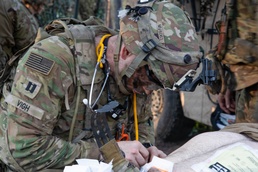
FORT POLK, La. — Soldiers from the 628th Forward Resuscitative Surgical Detachment pushed their capabilities closer to the front lines during a joint training exercise at the Joint Readiness Training Center (JRTC), testing how advanced surgical care can be delivered earlier in the evacuation chain to improve survival outcomes.
During May 2026, the San Antonio-based unit trained alongside Role 1 medical elements from the 10th Mountain Division, an integration that challenged the FRSD to operate further forward than its standard Role 2 position.
"Our main training objective this time around is to see how we incorporate with the Role 1 and with the 10th Mountain Division. Are the skills we provide to the frontline conducive to their mission as well." said Maj. Joshua Strommen, an emergency medicine physician with the 628th FRSD. "Our objective is to see how well we can put our skills in with their skills."
Strommen said the exercise also forced the unit to confront a central question of large-scale combat operations: whether moving surgical capability forward could meaningfully reduce casualties before patients reach higher echelons of care.
"Our mission doesn't change," he said. "But the help that we can lend in those scenarios can really bring cutting-edge, life-saving interventions closer to the point of injury."
Spc. Angel Martinez, a practical nursing specialist and noncommissioned officer in charge of the ICU section for the 628th FRSD, said his role centered on managing post-operative patients following damage control surgery, keeping them stable until they could be transported to a higher echelon of care or returned to the fight.
He said training under large-scale combat operations conditions added a layer of complexity the unit doesn't face at Role 2, where evacuation timelines are shorter and the surgical element operates further from direct contact.
"Being on the front lines with the Role 1 medical unit, normally we're further back, but being in the front lines with them and seeing the capabilities that they have augmented with what we're capable of doing has been a real challenge, and a good challenge, to provide better care for soldiers," Martinez said.
The unit, which typically deploys as a 20-person team capable of splitting into two 10-person elements, also faced environmental challenges during the rotation. Accustomed to San Antonio's hot, dry climate, soldiers contended with persistent rain and humidity throughout the exercise.
"It's been hot and wet," Martinez said. "It's been raining the whole time we've been here, just embracing the suck."
Strommen said the ultimate measure of success for the rotation was simpler than any tactical metric.
"The biggest focus is for us to know what our roles individually are so that we can resuscitate a patient and give them a chance to get back home," he said.