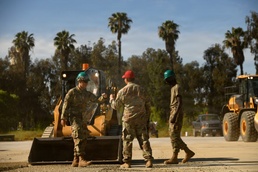
MARCH AIR RESERVE BASE, Calif. — Seven instructors assigned to the 163d Regional Training Site are strengthening mission readiness across the Total Force by training more than 1,000 Airmen annually in Rapid Damage Repair and other Civil Engineer specialty courses. Through technical expertise, mentorship, and teamwork, the instructors prepare Airmen to restore critical airfield operations in demanding environments around the world.
“We’re building good foundations here. We’re teaching them things they can’t do at home-station. By the end of the week, they are operating equipment with confidence,” said Senior Master Sgt. Reuben Dominguez, 163d Regional Training Site superintendent.
RDR is an essential capability for Civil Engineer Squadrons and plays a critical role in sustaining airfield operations during contingency, restoration, and disaster-response missions. The RTS provides the equipment, training environment, and instructor expertise needed to ensure deploying Airmen are mission-ready before arriving in theater.
“We teach them to a standard directly tied to deployment operations where damaged airfields have to be recovered within a specific timeline so aircraft can land and take off,” said Master Sgt. Scott Eversole, 163d Regional Training Site instructor. “In some scenarios, we may be isolated at a location with little to no options. That means not only repairing the airfield, but sometimes training augmentee Airmen on the spot to help accomplish the mission.”
This iteration of the week-long course was comprised of Airmen from 11 different Wings learning how to execute full-scale crater repair procedures, beginning with debris removal and upheaval marking before progressing through excavation, backfilling, compaction, and surface restoration. RTS instructors evaluate both completion time and structural performance, conducting repair quality criteria testing to ensure repairs can withstand projected aircraft loads and operational demands.
Beyond teaching technical skills, the instructors focus heavily on building teamwork and confidence among students who often arrive with little familiarity with one another but must quickly learn to operate as a cohesive unit.
“We have people coming here from across the service, and they have to perform together throughout the week even though they just met,” said Eversole. “I try to instill confidence in them that they can do this. After 15 years as an instructor, I’ve learned how important motivation and teamwork are to getting the mission done.”
That same culture of teamwork exists within the instructor cadre itself. Because each instructor serves as the sole subject matter expert for their Air Force specialty code, successful course completion depends on strong cross-functional support and collaboration. To strengthen the team, instructors conduct monthly professional development sessions focused on communication, leadership, and public speaking.
“We’re one deep in each AFSC, so you have to be very proficient in your job, but also willing to jump in wherever needed,” said Dominguez. “Our team is strong because we don’t hesitate to help each other.”
When the airfield is attacked, individual AFSCs blur; everyone operates a saw, drives a skid steer, or pours concrete. It’s an all-hands-on-deck fight to clear explosive hazards, cut, fill, and cap craters to restore a minimum operating strip in hours, not days.
The effectiveness of the 163d RTS reflects the 163d Attack Wing’s commitment to developing resilient, mission-ready warfighters prepared to operate in complex environments. By combining technical excellence with mentorship and teamwork, the instructors ensure Airmen across the Total Force are ready to restore airpower anytime and anywhere the mission requires.