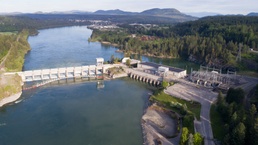
When the U.S. Army Corps of Engineers (USACE) awarded a $20,395,700 contract Feb. 26, it marked more than just a maintenance milestone for Albeni Falls Dam, located in Oldtown, Idaho.
It signaled a shift in how federal infrastructure projects are delivered—prioritizing efficiency and community transparency over bureaucratic hurdles and working as a regional team, leveraging engineering expertise from U.S. Army Corps of Engineers, Walla Walla District, to efficiently deliver the design.
The contract initiates the comprehensive 11-gate spillway replacement project, a vital effort to ensure the dam continues to provide flood control, hydropower generation, navigation, fish and wildlife conservation, and recreational opportunities for the Pend Oreille region for decades to come.
"Albeni Falls Dam was built with a clear mission: to manage flood risk, generate hydropower and support the region’s economy and environment,” said U.S. Army Corps of Engineers, Seattle District Commander Col. Kathryn Sanborn. “These new gates are essential components of the dam that allow us to execute these authorized purposes without the operational constraints we’ve faced recently. This project ensures we can manage water precisely; balancing water elevations for summer recreation with the vital task of keeping communities safe during spring runoff."
A Focus on Efficiency
The spillway gate replacement project serves as a primary example of Assistant Secretary of the Army for Civil Works (ASA (CW)) Adam Telle’s' Build Infrastructure, Not Paperwork’ initiative to modernize the civil works program and sharpen focus on delivering critical national infrastructure.
“The U.S. Army’s Civil Works program has been an invaluable cornerstone for more than 200 years,” said Telle. “The ‘Building Infrastructure, Not Paperwork’ will return USACE to focus on its core missions and ensure the enterprise continues to be the most trusted national resource delivering water resources solutions.”
Launched Feb. 23, the plan, which includes five Areas of Effort and 27 Initiatives, prioritizes core missions that serve the national interest, directs funding to high-priority water resources projects and minimizes non-core activities.
The Albeni Falls Dam spillway gate replacement project aligns with the ASA (CW)’s Initiative,(Area of Effort #3: Focus on Efficiency) that empowers streamlining acquisition processes and coordinating closely with federal partners such as Bonneville Power Administration (BPA),on funding requirements and gate replacement strategy, and non-federal partners to obtain the necessary appropriated funds. Seattle District applied these measures to ensure communication remains consistent, while aligning with Administration priorities.
By providing a clear and predictable roadmap for construction, this approach strengthens USACE’s relationships with stakeholders, Tribal Nations and congressional representatives.
“Since 2023, Seattle District and our partners have worked together on both short and long-term efforts to increase operational flexibility at Albeni Falls Dam, and this project directly supports the ‘Build Infrastructure, Not Paperwork’ initiative,” said Sanborn. “Following the 2024 rehabilitation assessments, the Army Corps evaluated several potential courses of action and ultimately decided to move forward with a comprehensive gate replacement plan. By streamlining decision-making and focusing on a permanent engineering solution, we are reducing bureaucratic delays and delivering a more resilient Albeni Falls Dam more quickly and cost-effectively for the American taxpayer.”
One of the core tenets of the Initiative’s drive toward efficiency is to prevent the spread of misleading information regarding resource availability. By being transparent about the project’s scope and funding, USACE empowers local partners and the public to make informed decisions regarding their own economic and safety planning.
Spillway Gate Defect History
From 2023 to 2026, USACE consulted and worked with various stakeholders, including BPA and industry leaders, to move from gate defect discovery toward contract award.
Discovered in April 2024 during routine maintenance, Spillway Gate 3, one of the dam's 10 spillway gates (plus one spare), revealed defective steel; likely a consequence of the original 1950s fabrication process. This finding prompted Seattle District to restrict operations on the gates that were in service to ensure safety and stability. Gate restriction involved limiting the number of gate movements as much as possible; only opening or closing100 percent with no in-between stages.
While USACE developed their long-term plan for complete gate replacement, it had to create a robust, interim solution to bring Gate 3 back into service and increase the dam's operational flexibility. The team determined installing Fiber Reinforced Polymer (FRP) offered a technically superior adhesive “bandage” to provide significant structural enhancement.
A technologically advanced material, FRP’s composite nature provides excellent fatigue resistance, making repairs more resilient to the repeated stresses of opening and closing and the dynamic forces of flowing water; translating to a durable repair that can reliably perform its function until the full gate replacement program is complete.
After Gate 3returned onsite May12, USACE then moved forward with preparing it for FRP installation. This process included applying layers of polymer “fabric,” adhesive and epoxy. The team began FRP installation the week of June 2 and completed the process by the end of July 2025.Gate 3returnedto service in August 2025.
With Gate 3 back in service, Seattle District then leaned forward on the11-gatereplacement project, and to have a contract awarded inearly2026.
"This contract award marks a critical turning point for the communities surrounding Lake Pend Oreille,” said Albeni Falls Dam Operations Project Manager Amanda Smith. “By moving from a strategy of repair to a full replacement of these 11 spillway gates, we are eliminating the long-term uncertainty caused by aging steel. Our priority is to restore this infrastructure’s reliability so the public can depend on the Army Corps to deliver its mission for decades to come."
Path Forward
With the replacement contract now on course, USACE engineers and the contractor are finalizing a rigorous schedule. The logistics of replacing massive spillway gates on an active dam require precision:
This staggered approach allows the facility to remain fully operational, ensuring water management and power generation continue without significant interruption.
Securing the Future of Lake Pend Oreille
Albeni Falls Dam is a cornerstone of Idaho’s regional economy. The original spillway gates have served the Inland Northwest reliably for70years, but modernization is essential to mitigate the risks of aging infrastructure. New, more resilient gates mean more than just technical reliability; they represent a promise to the community. Whether maintaining the lake levels that support a thriving summer recreation season, or managing spring runoff to prevent flooding, Albeni Falls Dam is an investment in the Pacific Northwest’s safety and prosperity. As the first gate moves toward production, Albeni Falls Dam shows what can be achieved when the focus remains on building the infrastructure the nation needs today for the challenges of tomorrow. ###
Albeni Falls Dam consists of the powerhouse and the spillway. The spillway stores water for downstream power production and irrigation at other dams along the Pend Oreille and Columbia Rivers, or releases water for upstream flood control. There is 136,000 cubic yards (61 million pounds) of concrete in the structure. The powerhouse contains powerful turbines and generators that convert gravity-driven river water into hydroelectricity. When generating at full capacity, the three Kaplan generators can generate 42.6 megawatts (MW) of electricity, enough power to supply about 15,000 homes. This power production saves the United States from buying about 4.9 million barrels of imported oil each year. BPA markets this electricity through its grid to many regional locations in Idaho, Washington, Oregon, Montana, California, Wyoming, Utah and Nevada. BPA distributes and sells electricity produced at federal power plants in the Northwest to public and private utilities. Today, it produces over 200,000 MW hours of electrical energy annually.