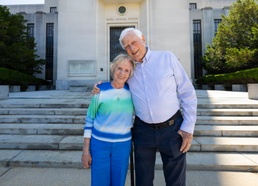
More than five decades after a Navy pilot and Navy nurse met at National Naval Medical Center (now Walter Reed National Military Medical Center), Mike and Carol Flannery returned to revisit the place that changed their lives.
The tower was the first thing Mike Flannery saw.
Pulling up to Walter Reed, the former U.S. Navy Lieutenant spotted the original structure rising above the campus, the same building that loomed over his world for five months in 1969. The memories came back all at once.
"High emotion level, really," he said. "Seeing the original tower, which is what always sticks in your mind, and then the throwback to the memories of meeting my wife here 56 years ago. That was really something."
Beside him, Carol Flannery smiled. She said she felt butterflies.
The Flannerys traveled to Washington, D.C., this month for a family college graduation and to celebrate Carol’s 80th birthday. Of all the places she could have chosen to revisit, she wanted to return to Walter Reed, where Mike recovered after a devastating injury and where the couple first met. One of their three children helped arrange the visit.
“My siblings and I have always loved the story of how they met,” their daughter Brooke Anderson said. “The Navy brought our family together and we are thankful for that!”
"We should all go back and visit where we came from," Carol said. "And that's what we're doing."
In 1969, Mike had just finished flight school at Naval Air Station Lemoore in California and was assigned to Attack Squadron 215 aboard the USS Enterprise (CVN-65), the greatest carrier in the Navy fleet, he'll tell you, without hesitation. The carrier departed San Francisco, bound for Vietnam with a stop in Hawaii along the way for operational readiness exercises.
During flight operations, an F-4 Phantom near the catapult exploded after a Zuni rocket overheated from a jet starting cart. The aircraft on deck were loaded with bombs, fuel and rockets, and the fire moved from plane to plane. Mike was strapped in his cockpit at the far end of the flight line when he heard the explosion. He understood immediately what was happening.
He unstrapped from his harness and jumped nearly 10 feet to the flight deck below. He landed wrong.
"My right leg just snapped above the ankle," he said.
Mike was initially treated at Tripler Army Medical Center in Honolulu, but the injury required surgery. Because his home of record was New Jersey, the Bureau of Naval Personnel assigned him to the then, National Naval Medical Center, despite his repeated requests to be sent elsewhere. He had wanted Oakland Naval Hospital, closer to his squadron and the people he knew. The Bureau was unmoved.
"In their wisdom," Mike said, with the kind of dry delivery that suggests he has told this story many times and has made peace with the punchline.
When he arrived at Bethesda, and was admitted to the surgery floor, the first face he saw belonged to U.S. Navy Lt. j.g. Carol Pate. Fresh out of Officer Development School in Newport, Rhode Island, Carol had been assigned to recovery and intensive care during one of the busiest periods of the Vietnam War.
"It was hard to watch people come back," Carol said quietly. "They were bandaged. They were crippled. It was hard."
She grew up in a Navy family. Her father served aboard the USS Enterprise (CV-6) during World War II and later became a naval aviator, and she joined because she believed in the mission. She loved being a Navy nurse but credits the corpsmen for much of what she learned on those wards.
"I don't think I could have gone to nursing school and done half of what I did without the corpsmen," she said. "They were just amazing."
She was also under clear instructions not to fraternize with patients.
Mike was immediately undeterred. Her name badge gave him her last name, so the moment Carol entered his room to prepare him for surgery, he asked for her first name. She looked directly at him and answered, “Miss.”
As soon as she walked out, Mike turned to a corpsman. “What’s her first name?”
“Carol.”
"That was kind of the beginning," Mike said.
Carol knew exactly what he was after, and despite the rule against fraternizing, she had already made up her mind. She went home that night and found her roommate, Janie, who would join the Flannerys on this return trip to Washington decades later.
“I met the guy I’m going to marry,” Carol told her.
Their relationship developed gradually against the backdrop of hospital protocol and the unrelenting demands of wartime medicine. Carol kept her personal life close. Mike recovered on a ward known as Boys Town, home to many Marines returning from Vietnam. The friendships he formed there have lasted decades. Many of those same men later stood beside him at the Flannery wedding.
“Limping down the aisle,” Mike said with a laugh.
What came next, “was unremarkable in the best possible way,” Carol said.
A month into his stay, Mike was up on crutches and in need of clothes. He had arrived with little more than a flight suit. Carol offered to drive him to a clothing store in Georgetown.
Their first official date came not long after—a February afternoon at Great Falls Park, cold enough to be impractical, with a bucket of fried chicken and a man navigating trails on crutches.
"I must have figured out I was in love by that time," Mike said, "otherwise I wouldn't have done it."
The day before returning to Walter Reed, the Flannerys revisited Great Falls with family and friends.
After Mike was discharged and reassigned to Naval Air Station Cecil Field in Jacksonville, Florida, the couple maintained a long-distance relationship around military schedules and training flights. When Carol had time off, she flew to Jacksonville. When assignments brought Mike through Maryland, the couple found time together whenever they could. Distance was not going to be the thing that stopped them.
That July, Mike proposed at Carlisle Barracks in Carlisle, Pennsylvania, kneeling on the parade grounds outside her parents’ quarters. They married November 22, 1969, just 10 months after meeting at Bethesda. This Fall marks 57 years together.
Carol eventually left the Navy and followed Mike through military assignments, including a Mediterranean deployment, before he transitioned into civilian life after completing his service commitment. She continued her nursing career for years afterward.
More than five decades later, standing again inside Walter Reed, Mike reflected on what the hospital had given him beyond medical care.
“A lot of great care, great surgeons, great people,” he said. “And I’m glad to see it’s still thriving and growing and becoming the center of the medical system for the services. It makes me proud.”
When he and Carol were both asked what has sustained their marriage, the answers came easily —"faith, loyalty, service, and caring for others.” For the Flannery family, those values extended far beyond military careers. They became the foundation of a life together.