JOINT BASE MYER-HENDERSON HALL, Va. - Long before the first visitors arrive at Arlington National Cemetery for Memorial Day weekend\, the grounds have already been transformed.
It happens quietly.
In the early hours of the morning, nearly 1,000 Soldiers from the 3d U.S. Infantry Regiment (The Old Guard) move through the cemetery in near silence. There is no ceremony or audience, just rows of white headstones and a task repeated thousands of times over.
One flag. One marker. Move forward. Repeat.
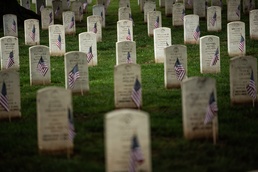
By sunrise, more than 250,000 American flags stand across the cemetery, each placed exactly one boot length from a headstone or niche column. The spacing is deliberate. The alignment is exact. The standard does not change, regardless of rank, section, or terrain.
Most visitors will never see how it happened.
They will see the finished result. Rows of flags stretching across 639 acres, marking the resting place of more than 400,000 service members, veterans, and family members. What they will not see is the movement behind it, units stepping off in the dark, covering ground section by section to ensure nothing is missed.
For Capt. Mikhael Smits, Casket Platoon Leader for Hotel Company, the mission carries meaning beyond ceremony.
“It’s easy when we do funerals day to day to focus on just that one because the standard here is perfection,” said Smits. “You don’t get to look around, and you don’t get to think about that history.”
This year marks the 79th iteration of the tradition.
Since 1948, when The Old Guard was designated as the Army’s official ceremonial unit, the mission has continued without interruption. Every available Soldier participates. There is no rotation or partial commitment, the expectation is total coverage.
In some areas, Soldiers move across open ground. In others, they navigate older sections where spacing is tighter and terrain is uneven. At the Tomb of the Unknown Soldier, Sentinels maintain their constant watch while ensuring flags are placed with the same precision.
Different locations. Same standard.
“Flags In is a time where The Old Guard Soldiers get to have the cemetery to themselves for a couple of hours,” Smits said. “We get to spend time with Soldiers that we didn’t get to bury, Soldiers that we did get to bury, and think about the meaning of their service.”
Beyond the scale of the mission, Flags In reflects a deliberate commitment. Every name, marker, and sacrifice is acknowledged equally. No area is overlooked, and no service member is forgotten.
For many Soldiers within the regiment, the mission also becomes one of the few moments where the entire organization works side by side in a single effort.
“The Old Guard is a big organization with a diverse mission set across the National Capital Region,” said Smits. “We’re actually excited to host Soldiers from the military police unit, from the Caisson Detachment, and from the human resources teams that normally work up in our headquarters, and they’re out here in the cemetery working with us as peers.”
There is no single moment that defines the mission. No formation or signal marks its completion. Instead, it ends the way it begins, quietly.
At some point, the last flag is placed.
When the cemetery opens to the public, the work is already done. Visitors walk among the flags, pausing at markers, reflecting on the scale of sacrifice represented across the cemetery.
As Arlington National Cemetery prepares to receive visitors for Memorial Day weekend, including observances such as the annual Flowers of Remembrance Day, the flags serve as a visual reminder of the cost of service and the enduring responsibility to honor those who served.
After Memorial Day, the flags will be removed just as deliberately as they were placed.
Until then, the flags remain stretched across the hills of Arlington, moving softly in the wind above generations of sacrifice, service, and remembrance.