FORT INDIANTOWN GAP, Pa. – The 166th Regiment - Regional Training Institute (RTI) is serving as the Army National Guard’s validation site for the Army’s new 29-day Basic Leader Course (BLC), helping refine the updated curriculum before it is implemented across the force later this year.
Conducted from April 28 through May 26, the validation course expands the previous 23-day curriculum into a more field-intensive leadership experience, placing Soldiers in tactical scenarios designed to evaluate decision-making, troop leading procedures and squad-level leadership under stress.
The validation follows a recent active-duty pilot course conducted at Fort Sill and positions the Pennsylvania National Guard at the forefront of implementing and refining the Army’s updated curriculum for junior noncommissioned officers before it is fielded force-wide later this year.
As part of the validation effort, RTI cadre from Nebraska, Colorado, Ohio, Mississippi and Vermont traveled to Pennsylvania to observe how the 166th Regiment planned and executed the new field-focused training events. The visiting instructors reviewed training products, lesson plans and evaluation methods that may later be adopted by RTIs across the National Guard enterprise.
“Nothing from the 23-day BLC course is being lost,” said Master Sgt. James Webb, Basic Leader Course chief of training for the 166th Regiment. “But a lot is being added – what we’re calling reps and sets – which is essentially an additional six or seven days of field training.”
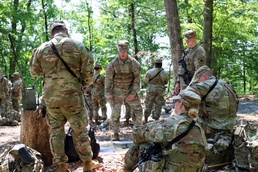
Under the updated program of instruction, students spend eight days in the field conducting leader stakes training, land navigation and a culminating situational training exercise, or STX, designed to evaluate leadership performance in realistic combat scenarios.
During the leader stakes portion of the course, Soldiers rotate through training lanes that hone their skill level 10 tasks — entry-level skills required of junior enlisted Soldiers, also known as warrior tasks and battle drills. These include medical skills, weapons proficiencies, patrolling techniques, and vehicle recovery operations that progressively build tactical proficiency and confidence while preparing Soldiers for leadership evaluations later in the course.
Some of the tasks students train on include reacting to ambushes and indirect fire, casualty evacuation and nine-line medical evacuation requests, patrol base operations and troop leading procedures. The training increases in complexity each day.
The culminating STX places Soldiers into leadership positions where they receive fragmentary orders, develop plans, brief subordinates and execute missions under time constraints and simulated battlefield conditions.
“The end goal is to develop team and squad-level leaders by putting students in a tactical position and having them execute troop leading procedures and make decisions,” Webb said. “We’re not grading them on their ability to do battle drills. We’re grading them on the ability to make decisions in a stressful environment.”
Implementing the new curriculum required significant coordination from the 166th Regiment cadre, who had only four days between the end of a previous BLC cycle and the start of the validation course. Instructors simultaneously developed operations orders, training aids, evaluation guides and lane scenarios while continuing to teach students.
During the course, Sgt. Maj. Elizandro Jimenez, U.S. Army Noncommissioned Officer Academy BLC course manager, visited the 166th Regiment to observe implementation of the new program of instruction and provide feedback on the evolving courseware.
“Pennsylvania’s cadre demonstrated exceptional adaptability while implementing this new curriculum,” Jimenez said. “The work being done here is helping shape how the Army develops future noncommissioned officers across the force.”
Students participating in the pilot course said the additional training time and increased tactical focus have made the experience more valuable and realistic.
“I think the extra week of training will really help people fully understand their roles as NCOs,” said Sgt. Tyler Kase, a combat engineer assigned to the Pennsylvania National Guard. “It’s changed my perspective as a leader and how I’ll handle things moving forward when I return to my unit.”
Sgt. Drayton Coyle, an infantryman and team leader with the Massachusetts National Guard, said the expanded field training better prepares junior leaders for unpredictable operational environments.
“You don’t know what’s going to happen in the Army,” Coyle said. “The operational environment and the way we fight is rapidly changing. Having that culminating event – that STX at the end of the course – will help us prepare.”
As the Army prepares to implement the updated 29-day BLC across the force, the 166th Regiment’s role in validating the curriculum positions the Pennsylvania National Guard as a leading contributor to the future of NCO professional military education.