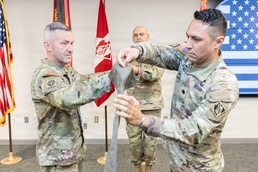
WINCHESTER, Va. – In a move to streamline operations and enhance mission efficiency, the U.S. Army Corps of Engineers (USACE) held an inactivation ceremony May 21 as the Expeditionary District stood down and the Southwestern Division’s Middle East District assumed its responsibilities.
This strategic realignment consolidates USACE’s engineering, construction, and other support services in the Middle East under a single district supporting the U.S. Central Command area of responsibility.
The Expeditionary District was USACE’s ‘tip of the spear’ district, with its personnel having been instrumental in supporting critical missions, including Operations Inherent Resolve and Spartan Shield.
“For the last several years, our team has been delivering for the warfighter in some of the world's most complex environments," said Lt. Col. Eder Ramirez, commander of the Expeditionary District. “This isn’t the end of a mission, but a deliberate evolution. We’ve built a strong foundation, and I have the utmost confidence that our colleagues in the Middle East District will continue to build upon that legacy with the same focus and unwavering commitment to the warfighter.”
Over the course of its service since 2021, the Expeditionary District managed a dynamic project portfolio, including hundreds of millions of dollars in contracting, construction, and engineering efforts. The district’s work was vital in enhancing the morale, readiness, and operational capabilities of U.S. military personnel in the region. Projects included significant upgrades to soldier housing and life support areas at contingency locations, replacing temporary tents with resilient structures and increasing billeting capacity for hundreds of personnel. Additionally, its Master Planning Team provided critical geospatial analysis and planning, supporting everything from defining legal boundaries to power and water distribution.
“Our contribution went beyond concrete and steel; it was about ensuring our soldiers had a stable platform from which to operate effectively,” Maj. Joseph Marut, the district’s deputy commander, reflected. “We took on the toughest challenges, from hazardous waste removal to delivering the first centralized power plant at a U.S. location in Syria. I am incredibly proud of the agility and resilience our civilian and military professionals have demonstrated every single day.”
USACE’s Middle East District, which will now assume the Expeditionary District’s missions, is no stranger to the challenges of the region, a fact emphasized by its commander, Col. Christopher Klein.
“The Middle East District in one form or another has been the U.S. Army Corps of Engineers’ enduring presence in the region for over 70 years,” he said. “We have the experience, and we have always worked closely with our expeditionary counterparts. Our partners in the region aren’t getting the Expeditionary District or the Middle East District; they are getting the U.S. Army Corps of Engineers.”