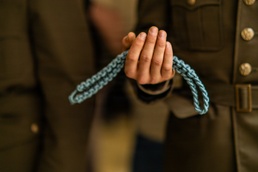
FORT BENNING, Ga. — “I have pinned more than 1,200 blue cords over the last three years, and the weight of that responsibility never gets lighter,” said Sgt. 1st Class Austin Farber, the 198th Infantry Brigade Drill Sergeant of the Year. “Every time I reach for that shoulder, I’m looking at 18 weeks of sweat, discipline, and a complete transformation. I didn't just train them; I shaped them into the Soldiers who will stand in the gap for this nation.” Farber, who previously served as a drill sergeant with Charlie Company, 2nd Battalion, 19th Infantry Regiment, understands the gravity of the Turning Blue ceremony. While the formal graduation at the National Infantry Museum the following day marks the completion of administrative requirements, "Turning Blue" is the emotional and professional apex for an Infantryman.
The morning begins on the paved parade decks of Pomeroy or Kanell Fields on Sand Hill, where families wait in the stands for a glimpse of the Soldiers they haven’t seen in 18 weeks. The silence is broken by the rhythmic strike of low-quarters on pavement and the echoing cadence of the drill sergeants as the formation marches onto the field in the Army Green Service Uniform. For the families in the stands, the challenge is identifying their loved one among the hundreds of Soldiers standing in identical military bearing.
The ceremony begins with the Soldiers standing in a rigid formation. The military stillness remains until the order is given for families to come forward. The stands empty as parents, spouses, and children move onto the field to find their Soldier. The formation dissolves into a sea of reunions as families reach for the right shoulder of their Soldier’s AGSU to secure the Infantry Blue cord. The moments that follow are filled with hugs, smiles, and the first photos of a newly minted Infantryman.
For the Soldiers without family in the stands, the ceremony is a moment of professional recognition. When a Soldier’s family is unable to attend, they coordinate with leadership ahead of time to select a mentor drill sergeant to perform the honors. As Staff Sgt. Jaron Frierson, a drill sergeant with Charlie Company, 2-19th Infantry, moved down the line to loop the cord onto the shoulder of Pvt. Brodie Heeney, he reflected on the 18-week journey that led to this moment. “I shaped that guy,” Frierson said, looking at the Soldier he mentored since day one. “I saw him when he couldn't march or hold a rifle, and now I’m welcoming him into the brotherhood as an equal. This ceremony lets them know this is not the end, this is only the beginning. They are no longer civilians; they are no longer trainees. Now they have the blue cord, they know the standard they must take to the force.”
This act symbolizes the professional bond between the instructor and the instructed. For 18 weeks, these drill sergeants have served as the primary architects of the Soldiers' character, teaching them that in the Infantry, the squad becomes the family. When a drill sergeant loops that cord, it is a formal passing of the torch, ensuring the legacy of the branch is handed down with the same discipline with which it was earned.
For Heeney, having his drill sergeant perform the honors served as a final validation of his status as an 11-series Soldier—the military occupational specialty code that officially designates him as a member of the Infantry. “The blue cord, to me, represents perseverance," Heeney said. "Going through this training wasn't easy, but it proved my determination. It’s a personal reminder that I have what it takes to reach the next level.”
The Infantry blue cord, established in 1952 during the Korean War, remains the primary heraldic symbol of the branch. Officially designated as Infantry Blue (Cable No. 65014), the four-strand nylon braid distinguishes the military occupational specialty as a specialized combat arm. That standard is rooted in the history of the Infantry, a legacy that Farber believes defines the character of those who wear the cord.
“If you look back at that lineage, it's something earned, not given," Farber said. "When I see a fellow Soldier wearing the cord, it tells me they are fit, lethal, and disciplined.”