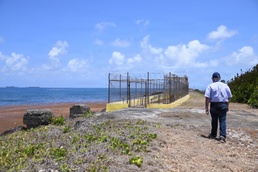
There is no better location to test the resistance, or lack of, to corrosion than at Tropic Regions Test Center (TRTC).
U.S. Army Yuma Proving Ground (YPG), the Army’s premier extreme natural environment test center, has test centers in Panamá in Central America and Suriname in South America, to test equipment to its limits in a demanding austere tropical environment.
Project Managers looking to evaluate if their test item can withstand moisture will get the full exposure experience at TRTC’s environmental exposure sites.
“It’s one of the most aggressive environments in the world regarding corrosion because of the time of wetness. It rains nearly daily here on the Atlantic side of the isthmus about 2000 millimeters per year. Also, because of the spray and the amount of salt in the air,” explained Rolando Ayala who recently showed the YPG and Arctic Regions Test Center (ARTC) command groups around the exposure sites in Panamá.
The moisture and salinity cause immediate degradation on equipment. The amount of salt in the air is about 1950 milligrams per square meter per year.
“When test items come here the deterioration and degradation accelerates. Because we have a lot of environmental factors that occur simultaneously,” explains Mel Nickell, Tropic Test Support Services Program Manager.
One example of this extreme deterioration was an exposure test on a HMMWV. The test called for one year in an exposure cage at the Atlantic side Breakwater Exposure Site in Panamá. After one month the degradation was significant. The exposure caused calcification and heavy oxidation on the hoses.
“This is when the vehicle became non-operational. After three months there were heavy leaks of fluid and the brake pads didn’t disengage,” explained Ayala. The test intended to measure effects on a military vehicle during seaborne transportation.
“They wanted to accelerate what would happen when they had the vehicles on the decks,” Ayala further explained.
Nickell added, “We have vehicles that break down at maybe 150 or 100 kilometers at other test centers, here it happens in 30 kilometers.”
The impact of the environment on a test item varies significantly based on factors, such as if the item is pretreated against moisture, is placed on the ground or on concrete or panels and if it’s facing the water.
“The difference between the seaside and the land side is amazing,” commented ARTC Technical Director Jeff Lipscomb of the degradation he saw on a case study. Another example involves radios for six months. Ayala said of the test, “We did a baseline with the radios along the firing range. After six months we operated the radios. Out of the five transmitters, only one transmitter operated.”
Ayala shared that the radios were previously tested in chambers, “They were deemed to be water and humidity resistant.”
But the true austere tropical environment got to the system when chamber testing did not. There’s no replicating the exposure to humidity and microorganisms. Between Panamá and Suriname, TRTC has several environmental exposure cages, climate and non-climate-controlled bunkers.
The Breakwater site sits along Panama Canal’s Atlantic approaches and the Coastal exposure site is further inland surrounded by grass and brush. In Suriname the cages are tucked away surrounded by jungle vegetation.
They vary in size and can accommodate small pieces of material up to a combat vehicle. So, the question is, can your test item make it in the jungle? TRTC can definitively provide that answer.