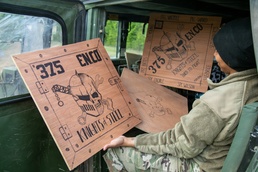
Hohenfels, Germany – Engineers from the U.S. Army Reserve are transforming training infrastructure during exercise Transatlantic Castle by applying construction skills and tactical engineering capabilities to improve training areas used by future rotational forces at the Joint Multinational Readiness Center’s (JMRC) Hohenfels Training Area May 11-31st 2026.
Soldiers assigned to the 467th Engineer Battalion and supporting elements spent the exercise constructing trenches, reinforcing field positions and converting existing structures into functional training facilities as part of a broader effort to enhance readiness across the JMRC.
For many of the Reserve engineers participating in the exercise, the mission provided a rare opportunity to work on large-scale projects from start to finish in a realistic operational environment.
“The key training objectives are really catered around getting real-world experience working toward a finished project,” said Capt. Kyle Hebl, the S2 officer-in-charge for Headquarters and Headquarters Company, 467th Engineer Battalion. “Anytime we can go out and work projects and see that transformation from start to finish, it makes the experience more valuable to both the Soldiers and the customers.”
Unlike training conducted at their home station in Millington, Tennessee, where they rehearse construction techniques without permanent outcomes, Soldiers at Hohenfels are completing projects that will remain in use long after the exercise ends.
“This is a lot different than our training back home where we’re moving dirt around, but then we have to replace it,” said Hebl. “Here, we’re working toward a finished project, and it’s way more valuable to the Soldiers to see that transformation from start to finish.”
Across the training area, engineers worked in teams to convert shoot houses into a water treatment facility and utility building. The projects required Soldiers to combine technical construction skills with military planning and adaptability in an unfamiliar environment.
“We’re converting these shoot houses into a water treatment facility and a utility building,” said Spc. Colin Fasking, a Soldier assigned to the 317th Engineer Construction Company. “We go out and we take a look at the prints, and we start getting all of our measurements and chalk lines and prepping our layout.”
The work involved a variety of construction materials and equipment commonly used in civilian framing operations including fasteners, anchor bolts and power saws. According to Fasking, the exercise also served as a refresher on core engineering fundamentals for junior enlisted Soldiers.
“You need fasteners, screws, nails, anchor bolds and you need saws,” said Fasking. “It’s all basic framing, so we went really quick over a class on that just to refresh the joes.”
Exercises such as Transatlantic Castle are designed to improve interoperability and readiness among engineer formations operating throughout Europe. Training at Hohenfels introduces additional complexities not often replicated during home station drills, including coordination with multinational units operating simultaneously across the training area.
“Here it adds a whole other consideration, like working in parallel with both international friendly units,” said Hebl. “We have to fully understand what it means to work in the same area of operations as other militaries and how our work and movement around the box is affecting other training missions.”
For Reserve Soldiers, the exercise also provides access to large scale construction opportunities that may not be available during standard weekend battle assemblies or annual training events.
“It’s a bigger opportunity here, said Fasking. “We have more space out here. We can build bigger buildings here than we can at home.
The demanding pace of construction operations challenged Soldiers to think critically and solve problems in real time. According to Fasking, one of the most difficult aspects of the mission was managing logistics and ensuring crews had the proper materials needed to continue construction without delays.
“The biggest challenge in an unfamiliar environment is probably going to be just running materials, said Fasking. “We showed up and we didn’t come out here first and walk around and see for sure what we need.”
Despite those challenges, leaders observed strong teamwork and initiative throughout the operation. Hebl credited the unit’s success to junior Soldiers and noncommissioned officers stepping into leadership roles and taking ownership of projects.
“A big reason why we’re being so successful out here is the combined effort from many levels to take charge and get tasks done,” said Hebl. “We’re breaking down into smaller teams, and we can only do that if the lower enlisted are displaying the courage and mental aptitude to lead a team.”
That decentralized approach allowed crews to complete multiple projects simultaneously and stay ahead of schedule while operating across dispersed locations throughout the training area.
By combining technical construction expertise, multinational coordination and hands on field engineering experience, Reserve Soldiers participating in Transatlantic Castle continue to strengthen the Army’s ability to build, adapt and operate in complex training environments across Europe.