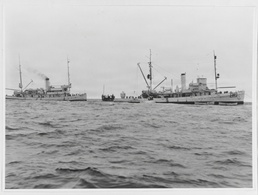
On May 23, 1939, during sea trials off the Isles of Shoals, USS Squalus (SS-192) sank 242 feet to the bottom after a failed main air induction valve flooded the aft compartments — killing 26 crewmen. USS Wandank (AT-26) joined the rescue, helping save 33 survivors.
Rear Adm. Cyrus W. Cole, commandant, Navy Yard, Portsmouth, took overall command of the rescue and salvage effort. During the rescue on May 24 and 25, Wandank worked with the submarine rescue ship USS Falcon (ASR-2), the submarine USS Sculpin (SS-191), the yard tug Penacook (YT-6), and Coast Guard vessels to rescue survivors. Together they helped keep Falcon positioned above the sunken submarine despite strong currents and rough seas.
Wandank’s steady station-keeping allowed Falcon to lower the McCann Rescue Chamber to Squalus’ forward escape hatch. The chamber made four successful trips and brought all 33 survivors safely back to the surface despite a frightening final trip.
On the McCann Rescue Chamber’s fourth rescue trip, the down-haul cable jammed and the up-haul cable began to fray. A diver was sent below to cut the down-haul cable, leaving Sailors aboard Falcon to haul the chamber by hand to safely pass the frayed section, all while Wandank helped keep the Falcon steady.
After the rescue, Cole directed the difficult task of raising the submarine and once again appointed Cmdr. Charles “Swede” Momsen to lead diving operations. Momsen introduced helium-oxygen breathing mixtures for deep dives. The shipyard became the main base for the operation, supplying divers, pontoons, rigging, and technical specialists. Divers spent months preparing the submarine for lifting.
Wandank remained on station throughout the summer. On August 12, 1939, with Squalus suspended underwater by pontoons, Wandank and Penacook attached towlines while Falcon acted as the restraining ship. The tugs towed the submerged vessel toward shallower water and grounded it on a sloping bank. Crews then reset the pontoons, repeating this procedure until Squalus was finally refloated and brought back to the shipyard.
On September 13, 1939, after 113 days of work, Wandank led a solemn procession of ships to Portsmouth Navy Yard at dusk. American flags flew at half-mast as Wandank towed the refloated Squalus the final distance upriver. Once the submarine was moored at berth six, shipyard workers used the heavy lifting crane to complete the difficult task of removing the remaining water from the flooded compartments before entering the interior to recover the remains of the lost crewmen. The Court of Inquiry found that mechanical failure in the operating gear of the main induction valve caused the sinking. The disaster led to important safety improvements in future U.S. submarines. The success of the Squalus operation, which saved 33 lives and recovered the sunken submarine, marked a major step forward in deep-water submarine rescue and salvage. Wandank’s steadfast service reflected the same spirit the Navy continues to emphasize today in forging the fleet to fight and win.