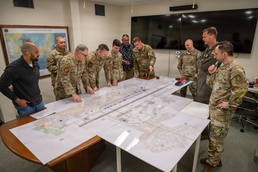
YOKOTA AIR BASE, Japan — Leaders from across the 374th Airlift Wing and mission partners participated in Yokota’s first installation-wide tabletop exercise focused on follow-on force sustainment, designed to test the installation’s ability to receive and sustain forces during a conflict while strengthening readiness through collaboration and strategic planning at Yokota Air Base, Japan, May 1.
Developed in partnership with the 374 AW futures office, the exercise used a large-scale map of the installation and movable pieces to simulate how units would compete for limited space, facilities and resources during contingency operations. The exercise was conducted in a series of sessions with action officers, senior noncommissioned officers and squadron leadership, allowing planners to refine the scenario and apply lessons learned over time.
“This is a war game that focuses on Yokota’s base support plan,” said U.S. Air Force Lt. Col. James Guthrie, 374th Maintenance Group deputy commander. “Rather than having to imagine what we would do or how we would do it, this allows our directors of staff and squadron commanders to actually see it in front of them.”
Representatives from the 374th Operations Group, 374 MXG, 374th Mission Support Group, 374th Medical Group, 515th Air Mobility Operations Group and other mission partners participated in the exercise, highlighting how each organization contributes to sustainment operations.
“It’s really easy for people to get focused on the planes and generating airpower,” Guthrie said. “The bigger part of Yokota’s role in any future conflict is receiving and sustaining those follow-on forces.”
By physically moving pieces across the board, participants identified competing requirements, deconflicted limited resources and developed solutions in the event of any real-world scenarios.
“This exercise gave us the opportunity to develop those strategic thinking muscles,” Guthrie said.
As Yokota continues to serve as a critical hub in the Indo-Pacific, exercises like this strengthen the Wing’s ability to integrate across the installation, maximize limited resources and ensure the base remains ready to receive, sustain and project air power whenever and wherever it is needed.