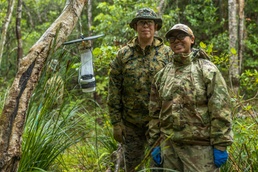
CAMP GONSALVES, Okinawa, Japan — Preventive medicine technicians with 3rd Medical Battalion, 3rd Marine Logistics Group, and Airmen with the 18th Civil Engineer Squadron, and 18th Operational Medical Readiness Squadron, both with 18th Wing, conducted joint preventive medicine training at the Jungle Warfare Training Center, May 4-8, 2026. The training enhanced proficiency in pest management, insect identification, sanitation, water testing and disease mitigation, strengthening participants’ ability to operate in austere environments while protecting force health.
Navy entomologists and environmental health officers led the training, integrating Sailors and Airmen in scenarios designed to mirror real-world contingency operations. The instruction emphasized safe pesticide use, water safety standards and public health protocols.
“This training brings together 3rd Medical Battalion preventive medicine technicians and Air Force pest management personnel from Kadena,” said U.S. Navy Lt. Gregory Pugh, an entomologist with 3rd Med Bn, 3rd MLG. “It shows how different services share the same mission to keep the force healthy.”
Participants learned about equipment including the Tempo Ultra water-soluble packets and the T-34 Igeba thermal fogger, applying pesticide barrier techniques and ultra-low-volume dispersal methods to control disease-carrying vectors such as mosquitoes and ticks. Teams also emplaced Centers for Disease Control and Prevention miniature light traps to monitor insect populations.
The training also addressed environmental hazards unique to Okinawa. U.S. Navy Lt. Cdr. Riley Tedrow, an entomologist with 3rd Med Bn, 3rd MLG, demonstrated safe handling procedures for the Hime Habu, a venomous snake found on the island, building confidence and reinforcing proper response techniques in field conditions.
“It’s about teaching preventive medicine personnel how to protect the warfighter,” Pugh said. “From ensuring safe drinking water to preventing mosquitoes and tick-borne illnesses, our job is to reduce risk so Marines can stay focused on the mission.”
By operating together in a realistic jungle environment, participants strengthened joint interoperability and reinforced the role of preventive medicine in sustaining combat readiness.