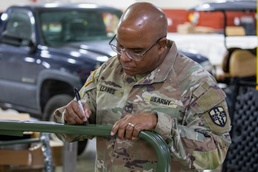
SAN ANTONIO – U.S. Army Reserve Soldiers in and around the organizational umbrella of the Pinellas Park, Florida-based Army Reserve Medical Command have been synchronizing efforts with the U.S. Air Force to conduct pre-check inventory packing, or PCIP, and transportation of medical materiel and other relevant supplies with the Theater Lead Agent for Medical Materiel, or TLAMM, here this past year.
Army Reserve Master Sgt. Francisco Llanos, the AR-MEDCOM medical logistics noncommissioned officer in charge, said TLAMM is the primary organization in which the influx and outflow of medical logistics and supplies take place — in order to support AR-MEDCOM and other Army Reserve units, known in military parlance as Compo 3, training exercises and real-world medical missions throughout the Continental United States, or CONUS, and in the U.S. Southern Command theater of operations.
Llanos said the interconnection between AR-MEDCOM and TLAMM arose from emergent requirements from the unit’s previous experience in orders requests with the Department of War Identity, Credential and Access Management, or D-ICAM. Furthermore, he drew inspiration to establish said connection from AR-MEDCOM to the TLAMM from his previous involvement with the logistics agency during his Regular Army tenure in 2012.
“The TLAMM works better for supporting our mission based on capability, based on rapid response and based also on price — so we’re saving money,” said Llanos. “Basically, because we are a Compo 3 (unit), we are not priority number one. With the TLAMM, we are Priority Number One — so, everything we order, we get on time, and the lead time that we order stuff through the TLAMM and when we get it is less than 30 days,” Llanos said. With the process of the TLAMM, you’re getting the stuff from the shelf yourself and you’re preparing for your mission as you go, so you know exactly what you’re getting and exactly what you’re going to get to the mission,” said Llanos.
Another benefit to the AR-MEDCOM connectivity with TLAMM is the adoption of U.S. Air Force methodologies to further refine AR-MEDCOM inventory management and conveyance of medical materiel, Llanos said.
“We have an exchange of expertise between us — like medical logistics from the Army and medical logistics from the Air Force,” said Llanos. “We learned that we also have better connectivity to the outside, to the prime vendors through the TLAMM than the previous system that we used before.”
Army Reserve Capt. Kelly Sambrano, a clinical operations officer assigned to the Nashville, Tennessee-based Southeast Medical Area Readiness Support Group, or MARSG, said her twice-consecutive engagement in PCIPs with the TLAMM has streamlined the overall process due to established standardization.
“We were able to make our (protective cases) and we kind of already had a set standard of how we wanted those built out, so it cut down on that time,” Sambrano said. “We’ve also had a bunch more resources this time, so having more Soldiers being here from different MARSGs has really helped and gives them the buy-in to be able to use the supplies and medical stuff in a way that works best for them.”
Bringing in subject-matter experts of disparate Military Occupational Specialties and Areas of Concentration, respectively MOSs and AOCs, throughout the AR-MEDCOM enterprise greatly diminishes any erroneous or inaccurate order requests, said U.S. Army Reserve Maj. Heather Kapperman, a family medicine physician for the Rochester, Minnesota-based 7212nd Medical Support Unit.
“It’s been very insightful to see the ordering process and to see what we’re using because what we need doesn’t always line up with the computers and the people placing the orders are not always medical, so it’s been very enlightening to where there can be mistakes made that we can better prepare for,” said Kapperman.
The AR-MEDCOM Soldiers have shared the consensus that their experience with TLAMM has been mostly positive, Sambrano said.
“I think the process has been outstanding,” said Sambrano. “Working with the TLAMM and the Air Force here has been great; they’ve been so supportive of our mission and getting to meet other Soldiers from other MARSGs has been fantastic.”
“I think now that people are starting to realize what AR-MEDCOM is tasked to push out with ordering all the supplies and how that’s working; we’ve been able to downsize on things that maybe are not as needed…and also work with the things that our providers feel we do need by getting those items advanced so that it is mission success.”
The AR-MEDCOM interconnectivity with the TLAMM warehouse here underscores Army Reserve-wide endeavors in transformation and modernization — ensuring an amplification in readiness to mobilize and deploy in a manner advantageous to the Total Army and the Joint Force.