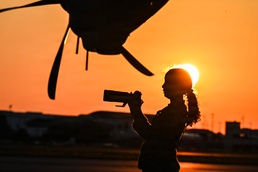
In a matter of hours, the 19th Airlift Wing transformed into a combat-ready Air
Expeditionary Wing, quickly mobilizing hundreds of Airmen during exercise STORM FLAG
26-07 at the Combat Readiness Training Center in Gulfport, Mississippi, May 9-16, 2026.
The milestone event pushed Airmen through around-the-clock operations designed to mirror the
speed, pressure and uncertainty of modern combat, testing whether the wing could rapidly
deploy, establish command and control and sustain operations in a contested environment. SF
26-07, designed by the USAF Expeditionary Operations School’s 34th Combat Training
Squadron, also marked Air Mobility Command’s Joint National Training Capability accredited
certification exercise for Air Expeditionary Wings.
“It’s the culmination of 12 months of readiness because this is where we finally came together as
a team and tested all our capabilities in the field against a high-end scenario to validate our
operational procedures,” said U.S. Air Force Lt. Col. Dillon Deutsch, 19th Air Expeditionary
Wing Chief of Staff.
Dillon said, the CTS and local Inspector General teams spent months building combat representative training designed to replicate current operational challenges, giving participants the opportunity to train in a controlled environment while working through real-world obstacles they could face downrange.
“We were able to give our Airmen the reps and sets while empowering them at the lowest levels
to make tactical decisions and lean on one another,” said Col. Bret Echard, 19th AEW
commander. “The environment and the mindset we created here is unlike anything I’ve ever
seen and that’s because we know that tomorrow’s fight will be anything but normal, and the 19th
Airlift Wing will be ready for it.”
While the 19th AEW functioned as the command control element, they brought with them two
newly implemented Air Force constructs created in 2025, the 19th Combat Air Base Squadron
(CABS) and the A-staff.
“This time last year those two constructs didn’t exist...we took it from a concept on paper at the
headquarters-level all the way to this exercise six months later,” said Deutsch. “That is a
testament to the hard work and determination of the wing and what we can accomplish.”
The newly established CABS brought together hundreds of Airmen representing 58 Air Force
Specialty Codes making up more than half of the participants of the exercise to provide base
operating support for the exercise.
“Our role here was to enable base operating support and the integration between what we
provide and host nation capabilities,” said Lt. Col. Freddie Stephens, 19th CABS commander.
That integration extended beyond mission execution and into how Airmen trained and operated
together throughout the exercise. Stephens says his unit’s “One Team, No Seams” mantra isn’t
just a patch but a cultural mindset. He opts not to wear his occupational badge to reinforce the
mindset that all Airmen are interchangeable and mission ready.
“We never know when we’re going to be downrange and won’t have full and robust capabilities,
said Stephens. “A lot of our training is centered around building that connective tissue outside of
our functional capabilities.”
While the CABS focused on sustaining base operations, the 19th AEW utilized the 39th Airlift
Squadron from Dyess Air Force Base, Texas, as its mission generation force element (MGFE) to
execute combat airlift operations.
“Our participation in this event is an essential piece to the AEW certification, providing mission
generation from the main operating base in support of the exercise’s Air Tasking Order,” said Lt.
Col. Jonathan Klenk, 39th AS DO & MGFE commander. “Practice as a team, especially as a
deploying team, hones the critical skills necessary to shaping us into a lethal force.”
The team provided combat airlift and airdrop support from Gulfport until a simulated incident
required a rapid relocation of operations, demonstrating the agility necessary in a contested
environment. The transition showcased the core of Agile Combat Employment, as a diverse
Mission Sustainment Team (MST) composed of multiple AFSCs established operations and
restored mission capability in a new environment.
The employment of MSTs represented the first time Air Mobility Command utilized this
capability in conjunction with an MGFE.
“They represented the trifecta of a mission force element...this enables rapid maneuvering or
repositioning because they can actually follow on and provide support,” said Deutsch.
What began as a rapid transformation exercise ended as a glimpse into the future of combat
operations with smaller teams, faster decisions and Airmen trained to keep fighting through
disruption.
“Readiness is not built in theory but by high-end training under pressure,” said Echard.
“Throughout this week, we proved that we are prepared to execute exactly what the Air Force
needs us to do anytime and anywhere.”