Combined Joint Task Force – Horn of Africa Public Affairs
Camp Lemonnier, Djibouti – In the operational environment of East Africa, developing partnerships and reinforcing readiness culminates to the success of mission execution to secure regional stability. The exercise did not start with a scheduled brief, but with a sudden base-wide alarm, sending service members to immediately bunker down against a simulated threat.
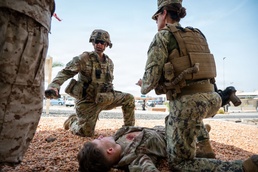
Combined Joint Task Force - Horn of Africa (CJTF-HOA) continuously tests its forces through exercises like Pale Serpent 26-3 at Camp Lemonnier and Chabelley Airfield, Djibouti, May 15, 2026. Exercise Pale Serpent is an iterative mass casualty response training that mobilizes a joint environment to test and enhance force protection and readiness protocols, while aligning Joint Force Protection with units like the 449th Air Expeditionary Group, along with joint service medical and security forces in support of the United States Air Force - Europe-Africa and U.S. Africa Command objectives.
“Africa stands at a crossroads where terrorism, malign influence, and economic competition demand dedicated engagement. USAFRICOM addresses these challenges by leveraging U.S. strengths to protect the homeland, advance U.S. interests, and respond to crises,” said U.S. Air Force General Dagvin R.M. Anderson, commander of United States Africa Command. “The men and women of USAFRICOM remain resolute in advancing U.S. interests while empowering African nations to secure their futures.”
That commitment to readiness was reflected throughout the Pale Serpent exercise as personnel from multiple branches responded to the simulated attack scenario.
After the simulated attack and bunkering down, the first members on the scene included base security forces personnel and the Quick Response Force unit, which set up perimeters and provided quick security augmentation to the simulated bomb sites.
“Training alongside our counterparts, such as the Master-at-Arms and Security Forces, improves coordination and helps ensure we’re ready to support the AFRICOM commander’s top priority of base defense,” said U.S. Army 2nd Lt. Thomas Flaherty, a platoon leader assigned to D Company, 2nd Battalion, 124th Infantry Regiment, Task Force Seminole.
While the QRF focused on securing the scene and responding to emerging threats, medical personnel concentrated on maintaining readiness to treat and evacuate casualties.
"Exercise Pale Serpent 26-3 aggressively tested our integrated mass casualty response capabilities,” said U.S. Army Maj. Giacomo Scorsese, CJTF - HOA Surgeon Cell director.
Medical professionals from multiple branches tested their techniques and communication in a high-stress, interoperable environment.
“The Surgeon Cell assisted with the coordination of medical assets across the entire Djibouti Base Cluster,” said Scorsese. “The concept intentionally stressed critical medical functional areas to their breaking point.”
Joint medical teams triaged and evacuated patients to the expeditionary medical treatment facility for more targeted trauma care and patient stabilization.
Scorsese notes that cross-branch communication proved to be the most demanding challenge.
“Accurate information flow ensures Battle Staffs can make real-time tactical decisions. Ultimately, resolving these challenges directly enhances our protection of the joint force," said Scorsese.
In addition to testing base security and medical readiness, Pale Serpent gave explosive ordnance disposal technicians the chance to practice rapid-response procedures for unmanned aerial threats. The exercise also strengthened their communication with partner forces while validating their ordnance identification and disposal procedures.
Exercise Pale Serpent brings together the full spectrum of force protection and anti-terrorism capabilities validating CJTF-HOA’s readiness to conduct operations throughout the Horn of Africa.