JOINT BASE LEWIS-MCCHORD, Wash -Excellence is difficult to achieve but sustaining it under pressure requires more than talent. It requires trust, preparation, accountability and a culture built before the moment of performance arrives.
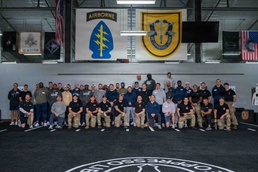
That pursuit of excellence brought the 2025 Super Bowl LX Champion Seattle Seahawks coaching staff to 1st Special Forces Group (Airborne) on May 15, for a leadership exchange focused on building, maintaining and sustaining elite teams.
The engagement included 1st SFG(A) senior leaders, Operational Detachment Alpha team members, and Tactical Human Optimization, Rapid Rehabilitation and Reconditioning (THOR3) staff with the goal to exchange best practices with Seahawks personnel on leadership, team culture, mental resilience, recovery and performance under pressure.
For 1st SFG(A), the visit offered an opportunity to share lessons from a formation built around small, adaptable teams capable of operating in complex environments throughout the U.S. Indo-Pacific Command area of responsibility.
1st SFG(A), based at Joint Base Lewis McChord, Washington, conducts special operations throughout the Indo-Pacific to support command objectives and U.S. national interests. At the center of the formation are Operational Detachment Alpha teams, commonly known as ODAs. These small teams are trained to work with allies, partners and the joint force with limited support.
For Seahawks personnel, the visit provided a chance to compare the demands of professional football with the demands placed on special operations teams. Both communities operate in environments where preparation, communication and trust directly affect performance.
The Seahawks Head Coach said one of the most noticeable parts of 1st SFG(A)’s culture was the consistency of its shared vision.
“I think the consistency of the shared vision of what they’re trying to achieve was just a great reminder of what works,” said Mike Macdonald, Head Coach for the Seattle Seahawks. “Let’s not lose sight of the daily things that we need to be doing to make our team great.”
Although the fields are different, both organizations rely on individuals who must understand their role, trust the people around them and execute when the stakes are highest. The similarities between the two organizations were visible in the way both groups approach upholding high standards.
“There’s a standard of what you’re trying to achieve, and how you do what you do every day is really, really important,” Macdonald said. “There’s nothing on the line that’s more important than what the Green Berets do, so it was awesome to learn from them.”
For one Green Beret, sustaining excellence in Special Forces means being prepared to perform beyond the standard at any time.
“The excellence part seems kind of implied,” said a Green Beret ODA Team Sergeant assigned to 1st SFG(A). “We have standards we need to meet, and everybody endeavors to well surpass those standards.”
That mindset shapes how Green Berets prepare before they are called to protect U.S. national interests in high-stakes missions.
“We could be called on to perform at or above those standards at any point,” the ODA Team Sergeant said. “Sustaining excellence is our bigger focus, whether that be maintaining readiness or training well beyond the standards so that even on a bad day you can perform at or above the standard.”
During the engagement, 1st SFG(A) senior leaders discussed how Green Berets cultivate elite culture through change and sustain excellence beyond a single mission or success. The discussion explored how those in leadership roles can support small teams making decisions under pressure and maintain cohesion in demanding environments.
For the Seahawks, success is measured in a wins-and-losses column. For a deployed team of operators, at its core, success is measured by life or death. 1st SFG(A) leaders expressed the need for teams to navigate ‘loses’ or ‘small failures’ during their train up, so they are better prepared when executing in a deployed environment. For the Seahawks that translates into practicing the way you want to play in a game, allowing failure in a practice setting, to ensure a high standard of execution is upheld for games.
The visit also allowed Seahawks coaching staff to hear directly from the ODAs about how they train. For ODAs, trust is not built through words alone. It is built through accountability, transparency and follow through.
“I think we build trust through accountability,” the ODA Team Sergeant said. “With that, we need transparency between everybody involved on the detachment, and with that transparency comes holding everybody accountable to both the standards, but also the things they say they will do.” That level of accountability applies across the team, from leadership to the newest member.
The ODA Team Sergeant said, “Through being held accountable, that’s how trust is built, because you know you can rely on people to meet those standards.”
One similarity between elite athletes and special operations Soldiers is the individual mindset required to keep improving.
“The individual mindsets of the people involved are very similar,” the ODA Team Sergeant said. “The players are very competitively minded, focused on improving themselves, much like our Soldiers are.”
He also noted that Seahawks coaches demonstrated the same willingness to seek improvement outside their own field.
“We similarly are always looking for those advantages and being willing to go outside of our own sphere to pursue knowledge that will benefit us in our own careers,” said the ODA Team Sergeant.
For Green Berets, physical preparation is only one part of readiness. Mental resilience, recovery, and expectation management contribute to the ability to deploy, operate and return ready for the next mission. The same whole-person approach is increasingly important across elite sports, where performance staffs focus on sustaining athletes through long seasons, high expectations and repeated pressure.
The engagement reinforced the importance of continuing to improve after major success.
“We’re not chasing the results,” Macdonald said. “Winning is great, but what we appreciate and what we are most proud of is our way of life and how we do things and the impact we have on the people around us.”
That approach, he said, keeps the organization focused on the process rather than resting on past accomplishments.
“If you just rest on your laurels and sit around and stare at each other all day, that’s not the life we chose,” Macdonald said. “Nothing really changes on that front.”
The exchange reinforced that elite performance is not built in a single event. It is developed through deliberate preparation, honest feedback, shared standards and a culture that values both individual growth and team success.
For 1st SFG(A), the engagement creating space for cross domain learning between two organizations built around high performance.
The visit left an impression on the Seahawks because of 1st SFG(A)’s openness and commitment to improvement.
“I want everyone to understand how much we appreciate 1st Special Forces Group opening up the doors, being so candid, so honest,” Macdonald said. “It just felt like a Group full of people that were really intent on making their organization better and serving the people that they interact with every day.”
As the Army continues to invest in Soldiers, engagements like this provide an opportunity to look beyond traditional military models and learn from other elite organizations.
Whether on a football field or in a deployed environment, the lesson remained the same, high performing teams are built before the pressure arrives.