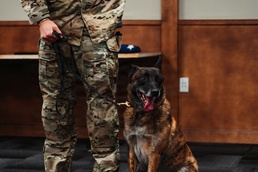
JOINT BASE LEWIS-McCHORD, Wash. — Two recently retired special operations Multi-Purpose Canines were honored by the 1st Special Forces Group (Airborne) kennel after years spent supporting missions across the Indo-Pacific region.
Master Sgt. Apollo and Master Sgt. Moker served as special operations Multi-Purpose Canines, part of a highly specialized capability within U.S. Army Special Forces that combines explosive detection, tracking and combat support operations into a single canine mission set.
Unlike conventional Military Working Dog programs focused primarily on law enforcement or installation security, special operations Multi-Purpose Canines, commonly referred to as MPCs, are trained specifically to support combat operations alongside Green Berets. According to handlers with the 1st SFG(A) kennel, the dogs are selected for fearlessness, intelligence and extreme drive before undergoing months of advanced operational training.
“We’re essentially looking for a fearless dog,” one Special Forces canine handler explained. “They’re not afraid of dark areas, heights, slick floors or anything they may encounter operationally.”
Handlers described the dogs as critical battlefield enablers capable of searching buildings, dense terrain and concealed positions far faster than human teams alone. “The biggest thing the dog brings to the fight is their nose,” the handler said. “We have eyes and guns. They have a nose.”
The dogs are frequently used during training exercises and overseas deployments throughout the Indo-Pacific region, where Special Forces teams work closely with allies and partners, developing their own canine programs. In addition to combat support, handlers said the dogs help build relationships with partner nations through joint training and instruction.
Moker, a Dutch shepherd born in Holland on May 2, 2020, entered the U.S. Army special operations canine program after being brought to the United States and beginning specialized training with the 1st Special Forces Group kennel in September 2021. He and his handler were certified as an operational MPC team the following month.
During his service, Moker deployed and trained across Mongolia, Japan, Thailand and the Philippines while also supporting missions throughout the United States. He helped train U.S. and partner forces in veterinary preventive medicine, canine care and Canine Tactical Combat Casualty Care.
Moker could detect 14 chemical odors, track targets across difficult terrain and conduct patrol and apprehension missions. He was also trained in advanced infiltration methods including fast-roping, rappelling, helo-casting and water infiltration operations.
Despite suffering multiple medical issues during overseas deployments, handlers said Moker continued to work through routine and emergency care situations without losing his drive or commitment to missions.
Apollo, a Belgian Malinois born Aug. 5, 2019, joined the kennel in November 2020 and later certified as an operational MPC in June 2023.
Throughout his career, Apollo supported overseas deployments, multinational exercises and special operations training events, including Cobra Gold.
Handlers described Apollo as exceptionally gifted at tracking operations, often becoming the preferred dog for difficult missions because of his ability to independently adapt to changing environments while pursuing a target.
He also became known around the kennel for his unpredictable personality. During one night-time training exercise, Apollo caught a rabbit while maneuvering through a mock village in complete darkness without his handler initially realizing it. He also developed a reputation for aggressively charging bee hives during training.
Handlers said the dog’s operational tempo often exceeds that of conventional military working dogs because of the demands placed on Special Forces units. While conventional military dogs may serve into their early teens, special operations dogs frequently retire much earlier because of the physical strain of constant deployments and high-intensity training.
In the case of Master Sgt. Apollo and Master Sgt. Moker they were swiftly adopted by families of 1st SFG(A). To adopt an MPC, you must meet specific criteria to ensure the dog transitions well and receives proper care and support. Candidates are identified six months from retirement for seamless transition.
Apollo’s new family described the experience as positive. They met every other day for a month to play with him and build a bond.
“It’s definitely rewarding seeing that shift from anxious to relaxed, from pacing around to laying on the ground with us in the sun”. The new owners said.
Moker found a home with the Group Support Battalion’s Commander, Lt. Col. Jonathan C. Nagle and his family.
“The process was simple, as they de-train, they get to know you better. He quickly became a member of the family,” said Lt. Col. Nagle.
The 1st Special Forces Group kennel remains a relatively small organization supporting a large operational footprint across the Indo-Pacific region. Handlers said demand for the capability continues to grow as partner nations increasingly seek special operations canine expertise and training.
For the Soldiers who worked alongside them, however, Apollo and Moker represented far more than a military capability.
Beyond tracking, detecting explosives and supporting Special Forces teams overseas, the two dogs became trusted members whose instincts, courage and personalities left lasting impressions on the Green Berets who handled them.