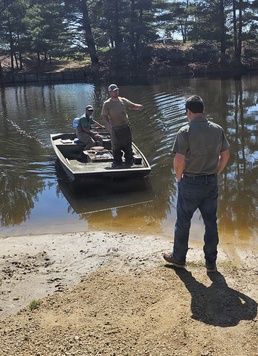
By the time Steve Rood officially stepped into Fort McCoy’s fisheries biologist role in 2023, he already knew Fort McCoy’s waters like few others.
From cold-water trout streams winding through the installation to the lakes and impoundments that support recreation, wildlife habitat, and military training, Rood had spent nearly two decades building an intimate understanding of the installation’s aquatic ecosystems before formally assuming the lead fisheries role.
Today, as fisheries biologist with the Fort McCoy Directorate of Public Works Environmental Division Natural Resources Branch, Rood continues supporting a wide variety of fisheries management activities that help preserve one of Fort McCoy’s most valuable natural resources while supporting the installation’s military mission.
For Rood, the position represents the continuation of a journey that began more than 20 years ago.
He first came to Fort McCoy in 2005 as a seasonal employee supporting the fisheries program through the Oak Ridge Institute for Science and Education while completing his education. After graduating from the University of Wisconsin-Stevens Point in 2006 with a biology degree emphasizing fisheries management, he joined the program full time. Three years later, that role transitioned under an agreement with Colorado State University, allowing him to continue supporting the fisheries mission.
When longtime Fort McCoy fisheries leader John Noble retired in June 2023 after more than three decades of service, Rood was the logical successor.
“I am very excited at the opportunity to be a part of the Fort McCoy Natural Resource Branch, and to be able to build upon the ideas and management objectives that I have been a part of over the last 15-plus years,” Rood said when he assumed the role. “I have spent a lot of time working on and developing an understanding of the different watersheds and landscapes on Fort McCoy, and I am eager to put that knowledge to use in order to maintain a high-quality fishery and military training.”
That understanding is critical given the scope of Fort McCoy’s fisheries program.
The installation includes 10 lakes and impoundments and approximately 71 miles of cold-water streams and tributaries, many of them Class I trout waters that support naturally reproducing brook and brown trout populations.
Managing those resources requires a diverse portfolio of work.
Rood’s responsibilities include conducting fish population surveys, stream and habitat assessments, invasive species management, aquatic habitat improvement projects, angler outreach, and collaboration with state and federal conservation partners. He also works closely with other members of Fort McCoy’s Natural Resources Branch to ensure fisheries management aligns with broader land stewardship goals and military training requirements.
“Aside from getting outside and conducting surveys, I really enjoy working with the other natural resource program managers to understand what their priority projects are and how we can all work together to accomplish those goals,” Rood said.
That collaboration is especially important at a military installation, where environmental stewardship and readiness must work hand in hand.
“There is definitely a balance that has to be struck between natural resource management, military training, anglers and many other stakeholders,” Rood said. “However, that balance is what we are all here trying to achieve — a high-quality military training landscape along with outstanding ecosystem that can support a wide array of recreational activities.”
Rood’s long history at Fort McCoy gives him a unique perspective on that balancing act.
Over the years, he has spent countless hours in the field, conducting surveys, evaluating habitat conditions, or meeting with anglers during creel surveys to gather feedback about fishing experiences on post.
Those conversations have stayed with him.
“Over the years I have conducted a lot of creel surveys, where I go out and talk to anglers about what they are catching and where they are from,” Rood said in a past article. “I would always end the survey by asking if they had any questions for me. Probably the number one answer over all the years that I received from anglers, was them thanking me for the work that we do and for the ability to fish on Fort McCoy.”
For Rood, those comments serve as a reminder that the work matters far beyond data collection and habitat management.
“That response shows how many of our anglers feel about the quality of fishing and habitat on Fort McCoy, and I will strive to keep it that way,” he said.
As Fort McCoy continues to support military readiness as one of the Army’s premier training installations, its natural resources remain an essential part of that mission.
For Rood, protecting those waters is both a professional responsibility and a long-term commitment — one built over decades along the streams, shorelines, and fisheries of Fort McCoy.
Fort McCoy’s motto beginning in 2026 is “Training the Total Force and Shaping the Future since 1909.”
The installation’s mission: “Fort McCoy strengthens Total Force Readiness by serving as a training center, Mobilization Force Generation Installation, and Strategic Support Area enabling warfighter lethality to deploy, fight, and win our nation’s wars.”
And Fort McCoy’s vision is, “To be the premier training center supporting the most capable, combat-ready, and lethal armed forces.”
Located in the heart of the upper Midwest, Fort McCoy is the only U.S. Army installation in Wisconsin. The installation has provided support and facilities for the field and classroom training of more than 100,000 military personnel from all services nearly every year since 1984.
Learn more about Fort McCoy online at https://home.army.mil/mccoy, on Facebook by searching “ftmccoy,” on Flickr at https://www.flickr.com/photos/fortmccoywi, and on X (formerly Twitter) by searching “usagmccoy.” Also try downloading the My Army Post app to your smartphone and set “Fort McCoy” or another installation as your preferred base. Fort McCoy is also part of Army’s Installation Management Command where “We Are The Army’s Home.”