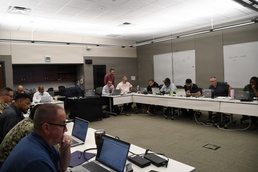
FORT LEAVENWORTH, Kan. — Mission Training Complex instructors from across the Army recently gathered at Fort Leavenworth, to enhance their skills with data-driven applications as part of a new Command and Control Low Code/No Code Basic Builder’s Course, May 4-8, 2026.
The “C2 Builder's Course” is a five-day intensive program designed to give participants foundational skills in Maven Smart System while creating operational data products for immediate use back at home station.
Leaders at the Combined Arms Command are focused on rapidly equipping Soldiers with the skills to build custom operational data products that provide tailored solutions to unit-specific problems. This course, the first of two pilots hosted by the Mission Command Center of Excellence, trained instructors from 11 Mission Training Complexes across the Army, including participants from Europe, Korea and Alaska, as well as other personnel supporting institutional and operational forces. Training equipped instructors with the skills necessary to rapidly deliver this course to Soldiers in supported organizations.
“Our aim is to create builders that are able to go into the Maven Smart System and create solutions for commanders, operational leaders and staff at the point of need,” said Lt. Col. Elvin Fortuna, a solutions architect in the CAC Command Data and Analytics Office.
Throughout the week, participants brought real-world, unit-specific problems to the classroom. The curriculum focused on foundational skills in data ingestion, transformation, and visualization using applications in Maven such as Pipeline Builder, Ontology Manager, and Workshop.
For participants like Jacob Rodriguez, the Individual Training Team lead at the Fort Bragg, North Carolina, MTC, the course directly addresses an increasing demand from the field.
"As Soldiers evolve with the basic skills, their commanders are asking for things that are a little bit higher skill level than just managing a map," Rodriguez said. "Commanders want to capture data and also create data sets. Right now, a lot of the Soldiers don't have those kinds of skills."
Justin Faye, a data scientist at MCCOE who helped develop the course, said the curriculum was built with significant help from the 10th Mountain Division, where leaders had already begun similar training efforts. "The intention is that every graduate of this program will be able to start building things in Maven," Faye said. "Building user applications either for their units or their commanders. They will be able to start feeding their data in and start to build applications, build AI [Artificial Intelligence] agents … some sort of product.”
Joseph Richard, the MTC Individual Training team lead at Fort Riley, said, "Our customers, the ones in the staff sections, the staff officers, they'll be able to build their own products to use on the system. For instance, when they’re giving briefings to their commanders, these tools will help them not only do that, but it will also help them with their battle planning.”
After the course, Rodriguez said he planned to meet with his leadership at Fort Bragg to develop a way forward. "This is what I learned," he said, as if talking to 18th Airborne Corps leaders. "How can we now facilitate your training based on these skills?"
Some students are using what they learned to help solve more specific operational challenges.
Jeffrey Chamberlain, a retired Army logistics officer and current technical writer for the 18th ABC MTC, leads a team of nine writers across four installations responsible for producing all corps and division-level operations orders. He is currently working on a project he calls "OPORD in a Box." His goal is to use the skills from the course to automate the production of OPORD documents, using his deep repository of orders and other historical documents to underpin this work.
"I proposed this three years ago, and everybody looked at me like I was crazy," Chamberlain said. "… The only platform that I've found that remotely has the capability to even begin to do what I want to do is Maven and Vantage, currently. I just don't know how to use it yet."
“This training,” he said, “is the first step in bridging the gap between his operational experience and the data literacy needed to build an application. This course opened my eyes to the gap that we have and where we are versus where we need to go.”
“I don't see why I can't have AI help enable staff production to replicate the subject matter expertise of 250+ subject matter experts across warfighting functions,” he added. “There's no reason in my mind why that can't happen. That frees up leaders to stop focusing on the ‘nugwork,’ and really focus on the planning, training and execution.”
A second pilot course is scheduled for June 8-12, 2026, which will pave the way for a future Advanced Builder Course that will produce an Additional Skill Identifier for graduates.
For further information, visit the Mission Command Center of Excellence website.