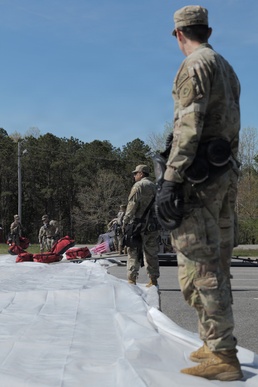
Massachusetts National Guard Airmen and Soldiers conducted a Chemical, Biological, Radiological and Nuclear (CBRN) Task Force collective training exercise on Joint Base Cape Cod, Massachusetts, May 14-17, 2026, to strengthen the state’s ability to respond to CBRN emergencies and other all-hazards incidents. The CBRN Task Force, CBRN and Explosive Enhanced Response Force Package (CERFP), is trained to rapidly deploy in support of civil authorities to save lives and mitigate human suffering during domestic emergency operations.
The exercise brought together 208 Guardsmen in a simulated disaster response scenario integrating multiple mission areas, including command and control, search and extraction, mass-casualty decontamination, medical stabilization, fatality search and recovery and incident site communications. The exercise simulated a nuclear explosion in a local area that caused radioactive material to contaminate the environment. The CBRN Task Force is trained to respond to such events, operating in 12-hour operational periods and sustaining operations for up to five days organically, with the ability to extend longer under certain circumstances.
“When we train independently, we tend to stay siloed and do not fully exercise interoperability, focusing only on our individual competencies,” said Lt. Col. Mark Bennett, 1st CBRN Task Force commander and deputy commander of Headquarters and Headquarters Company, 79th Troop Command. “Without bringing all elements together, it becomes difficult to see how each piece fits as part of the whole. All six departments rely on one another equally to accomplish the mission. While each element is designed to be plug-and-play and can operate with other teams, capabilities are more limited when we are not operating as a fully integrated team.”
Soldiers from the 101st Engineer Battalion formed the search and extraction team and trained on rope rescue, structural collapse search and rescue, and confined space search and rescue operations at the operations level.
272nd Chemical Company Soldiers trained to conduct mass-casualty decontamination operations for ambulatory and non-ambulatory patients, as well as technical decontamination for first responders. Soldiers also trained on wet and dry decontamination capabilities, equipment and personal property collection procedures, hazardous waste site establishment and maintenance and hazardous materials operations.
Airmen from Detachment 1, 102nd Medical Group (MDG) served as the emergency medicine consequence management team. The team trained to perform mass-casualty triage, provide lifesaving medical stabilization, coordinate transportation to higher levels of care, conduct radiation safety monitoring, provide respiratory protection, test potable water and monitor responder physiological conditions. The Medical Element (MEDEL) and Medical Capabilities (MEDCAPS) provide situationally dependent emergency medical triage, stabilization, treatment, tracking and regulation for patients, evacuees and support personnel. Medical personnel maintain responsibility from the point of initial contact through the established operational footprint until responsibility is transferred to civil authorities.
“The joint training environment gives us the opportunity to learn from each other’s experiences and combine our capabilities,” said Lt. Col. Eric Sabatinelli, Detachment 1, 102nd MDG commander. “We work closely with the Army, blending their skill sets with ours to accomplish the same mission. Training together strengthens our ability to operate as one team during a real-world response.”
104th Force Support Squadron members served on the fatality search and recovery team. Airmen trained on the expeditious and dignified recovery and removal of fatalities throughout the operating area, conducting search and recovery operations for human remains in contaminated environments, collecting and cataloging remains, coordinating with medical examiners and coroners, and performing hazardous materials operations.
The Joint Incident Site Communications Capability team, comprised of Airmen from the 102nd Communications Squadron, trained to provide access to commercial internet, NIPRNET and SIPRNET data services, public and military telephone services, reach-back support to National Guard support services, high-frequency radio communications and dedicated wired and wireless local area networks.
“Our mission is extremely important because, while we have a capability we hope we never have to use, we train for it in case the worst day in America were to happen,” said Bennett. “That’s expressly why we’re here, and we have all of these competencies brought to bear to ensure that if that day ever comes, we have a proper response capability ready to activate and take on that mission head-on. That’s what everybody out here is here to do.”