DALLAS —A storm system sweeps across Oklahoma and then into the Ozark Mountains of Arkansas and Missouri, dropping heavy rain that begins moving through interconnected river systems across the region. In the moment, to a driver caught in the downpour or a farmer watching fields, it’s just weather.
But the second that water hits the ground, it becomes the lifeblood of American commerce, energy and survival.
Within hours, that runoff enters a vast infrastructure network managed by the U.S. Army Corps of Engineers Southwestern Division. Here, the water is captured, controlled and put to work.
“Most people never think about how connected these systems really are,” said David R. Hibner, a senior executive service member and the programs director for the Southwestern Division. “The same water being managed upstream today may support navigation, hydropower, municipal supply or flood risk management hundreds of miles away downstream days later.”
In this highly synchronized system, every action creates a ripple effect. Heavy rains captured in reservoirs across Oklahoma and Arkansas today dictates the water levels that will keep cargo barges moving through the McClellan-Kerr Arkansas River Navigation System next week. During severe weather, engineers can hold back billions of gallons of water, relieving pressure on downstream Texas highways and businesses while quietly banking that same water to sustain cities during inevitable summer droughts. To understand the scale and national impact of this operation, you have to follow the water.
Through the Tulsa and Little Rock districts, the water surges through more than 35 lakes and a series of massive locks and dams. This forms the McClellan-Kerr Arkansas River Navigation System, which stretches more than 440 miles across two states. To navigate the nearly than 420-foot difference in elevation between the Mississippi River and the Port of Catoosa in Oklahoma, vessels must pass through a stair-step series of close to 30 locks and dams.
This infrastructure allows millions of tons of agricultural products, steel and fertilizer to move efficiently to and from global markets. When cargo moves by water instead of rail or highway, transportation costs drop significantly. That efficiency reduces wear and tear on the interstate highway system and ultimately helps keep the cost of consumer goods lower at grocery stores and hardware stores nationwide.
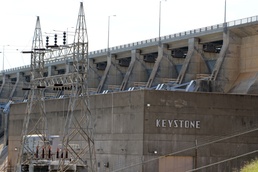
As water moves through dams across the region, it spins immense hydroelectric turbines, generating enough clean, renewable electricity to power an estimated 400,000 homes annually. Unlike traditional power plants, these hydroelectric turbines can be activated in minutes, providing critical peak-demand energy when regional grids are stressed.
Farther south, the Fort Worth District operates 25 reservoirs. They provide the balancing point between the intense water demands of expanding cities and the need to manage heavy rainfall across the region. The district manages contracts with local water authorities, holding conservation pools that supply drinking water to millions of Texans, while keeping flood pools empty to catch the runoff from sudden storms.
Finally, the system reaches the sea, where the Galveston District commands the navigation channels of the Gulf Coast. Managing more than 1,000 miles of channel frontage requires continuous maintenance to ensure deep-draft vessels can safely navigate one of the most economically vital maritime corridors on earth.
Beyond the statistics of tonnage and megawatts, this infrastructure is fundamentally about the people who live and work alongside it. It is the Oklahoma farmer who relies on the river to receive affordable fertilizer and ship grain overseas. It is the Arkansas factory worker whose plant operates on consistent hydroelectric power, and the families in expanding Texas communities whose daily lives depend on a steady, safe supply of drinking water. It is also the coastal residents whose homes and jobs rely on managed flood risks and thriving ports for economic survival.
The waterways also serve as community hubs. The reservoirs operated by the Southwestern Division are among the most visited in the nation, drawing millions of people to boat, fish and camp each year. This recreation sustains local economies, driving revenue to surrounding marinas, hotels and small business owners.
Sustaining this lifeline of commerce and community does not happen automatically. It requires unrelenting vigilance. At district water control centers, hydrologists and engineers monitor reservoir levels around the clock, analyzing weather forecasts to make precise, calculated adjustments to water releases. Out in the elements, lock operators manage vessel traffic 365 days a year, often in freezing temperatures or driving rain. Maintenance crews work inside drained lock chambers to repair machinery, while a rigorous Dam Safety Program continuously evaluates structural integrity to ensure facilities built decades ago remain safe.
Their daily, often unseen labor is what keeps the supply chain moving and communities protected. Nationwide, the Army Corps of Engineers oversees 750 dams, but the Southwestern Division stands out as one of the most complex water infrastructure missions in the country.
“Reliable infrastructure is directly connected to national strength,” said Brig. Gen. George H. Walter, commanding general of the Southwestern Division. “The Army Corps of Engineers helps ensure the systems supporting navigation, energy, water supply and flood risk management remain ready and capable of supporting the nation every day.”
This requirement for continuous modernization and readiness is a key focus for Army leadership. One of the hardest parts of the job, according to Assistant Secretary of the Army for Civil Works Adam Telle, is “explaining this to the public, because it’s all underwater.”
Telle recently called America’s navigation network a “secret weapon” for U.S. energy dominance and global competitiveness.
“This underwater infrastructure that nobody can see is actually the secret weapon of the United States of America. It’s the envy of the world,” Telle said. He noted that the ability to load ships fully in deep channels is what allows American energy and other products to be sent to global markets on an economically competitive basis.
Most Americans will never meet the lock operator working a midnight shift, see the structural upgrades happening on a nearly 50-year-old dam or notice the precise coordination required to pass a massive barge through a concrete lock.
But they experience the results of those people and those decisions every single day. They feel it when they flip a light switch, when they buy groceries shipped from the heartland and when they turn on the tap in a booming Texas city.
America runs on water. And day and night, the people of the Army Corps of Engineers are there, keeping it moving.