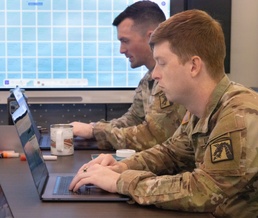
FORT BRAGG, N.C – Operational Data Teams (ODT) assigned to the Operational Data Section (ODS) at the Lt. Gen. James M. Gavin Joint Innovation Outpost are changing how XVIII Airborne Corps identifies and solves operational problems through Soldier focused software development and collaboration.
The ODS, part of the XVIII Airborne Corps G-5, oversees ODT that work on operational challenges submitted through Tactical Innovation Objectives. Teams are made up of members from different Military Occupation Specialties and ranks who work together to create software solutions that support mission requirements across the Corps.
“The teams are cross disciplinary and pick specific members so they are able to meet the needs of a balanced software team with a variety of perspectives to creatively solve the problems,” said Sgt. 1st Class Esther Kuttler.
The ODT have a stringent process to figure out the problems at hand. The process starts once a problem is submitted through the Joint Innovation Steering Process. Teams then begin researching and analyzing the issue to determine if it can be solved through software or data integration capabilities available within the ODS.
“The ODT go out and talk to Soldiers, civilians and even amongst themselves to figure out what the problem is,” said Chief Warrant Officer 3 James Lombrano. “If it’s a problem that we’re all familiar with, everybody has a different perspective.”
After identifying the operational challenge, teams conduct workshops, interviews and collaborative sessions to understand users' daily frustrations and operational requirements.
“The workshops usually consist of collaborative sessions where we map out our user’s daily frustrations,” said Kuttler. “Our teams brainstorm realistic, actionable solutions and we get to make progress by identifying where we can unlock the most impact immediately.”
The teams continue refining possible solutions by identifying root causes, expanding possible approaches and testing products throughout development. Products created by ODT are tested multiple times to ensure they meet operational requirements and user expectations before implementation.
“We look at the process itself to find friction points so that we can apply software to it,” said Lombrano. “We only look at the problem and continue vetting and looking through to make sure we can solve it with software.”
Communication between ODT and Soldiers remains a major priority during development. Team members work to establish realistic expectations early in the process while continuously updating Soldiers on progress and projected timelines.
Kuttler said that the ODT manages soldier expectations from the initial meeting by clearly communicating its capabilities and limitations.
Maintaining consistent communication throughout development helps prevent misunderstandings and ensures Soldiers remain informed during each phase of the process.
The ODT ensures user satisfaction throughout the process to deliver software that meets Soldier’s needs. The teams’ emphasis on communication and user feedback remains a critical part of the development process from start to finish.
Through collaboration, continuous communication and direct engagement with Soldiers the ODT continues to improve how XVIII Airborne Corps approaches operational problem solving. By identifying challenges early and developing adaptable software solutions, the teams help support mission effectiveness while ensuring products are built around the needs of Soldiers.