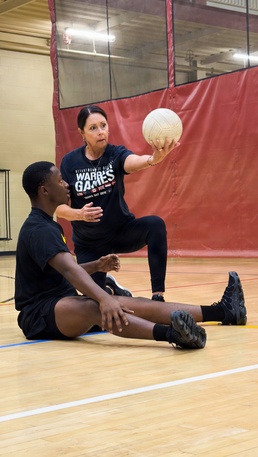
UNION CITY, Ga.– May 19, 2026 – Preparation for the 2026 Warrior Games begins long before competitors take the court. For sitting volleyball, much of that preparation happens during the Army Team Sports Camp, with team conversations and the steady guidance coming from the sidelines.
For Linda Pai, head coach of Team Army sitting volleyball for more than 10 years, the mission extends far beyond teaching strategy or refining technique. Her approach centers on helping competitors adapt, rebuild confidence and reconnect through competition and movement while reinforcing the resilience and teamwork reflected in the Warrior Ethos.
As Team Army trains in San Antonio ahead of the 2026 Warrior Games, Pai is leading a roster made up largely of new competitors learning the demands of sitting volleyball for the first time. The sport requires players to move quickly and react while remaining seated on the floor, creating both physical and mental challenges for competitors adjusting to adaptive sports and recovery.
Pai said the foundation of the team starts with understanding each competitor individually before expecting them to perform collectively. Early practices focus heavily on fundamentals, communication and building trust within the group. She also works to create an environment where competitors feel comfortable learning through mistakes while remaining engaged in the process.
“It all goes back to experience,” Pai said. “What they know, what they don’t know. Once we assess that, then it’s about fundamentals, teaching strategy and giving them the tools to continue improving.”
That individualized coaching style has become one of the defining characteristics of Pai’s leadership over the past decade. Rather than approaching every competitor the same way, she adjusts her communication and instruction based on personality, confidence level and how each person processes information under stress.
According to Pai, trust plays a major role in that process, particularly when coaching competitors recovering from visible and invisible wounds. Building that trust allows competitors to become more receptive to coaching while also strengthening accountability, communication and teamwork across the court.
“You can’t just tell competitors what to do and expect them to do it,” Pai said. “You have to explain the ‘why.’ Once they understand that, they buy in.”
While competition remains the goal, Pai believes adaptive sports provide something much larger than medals or wins. Through sports camp and the Warrior Games experience, competitors are introduced to new communities, resources and opportunities that often continue long after competition ends.
Pai also says that one of the most important lessons she hopes competitors carry forward is understanding that adversity does not define the end of their story. Instead, she encourages them to view challenges as another season to work through while continuing to move forward.
“You might not like the season you’re in,” Pai said. “But the next season might bring joy because you learned something new. Then you become strong enough to pass that along to somebody else.”
Her perspective closely aligns with the Warrior Ethos many competitors carried throughout their military service: commitment, resilience and refusing to quit when faced with adversity. Pai said adaptive sports help reinforce those same values while giving competitors a renewed sense of confidence and identity.
That mindset also shapes how Pai views resilience. Rather than treating resilience as a motivational phrase, she believes that it develops through repetition, accountability and continued participation. Practices are intentionally structured to encourage competitors to think independently, communicate with teammates and gradually take ownership of their development both on and off the court.
On the sidelines, Pai uses concise verbal cues and guided instruction to help competitors react quickly during competition without becoming overwhelmed by constant coaching. Over time, she said those lessons begin transferring naturally among the team, with competitors coaching and encouraging one another during drills and gameplay.
Although Pai emphasizes growth, enjoyment and connection, the competitive standard remains high. She expects discipline, effort and accountability from every competitor while reinforcing the importance of effort and teamwork under pressure.
Moving into Warrior Games, Pai hopes competitors leave San Antonio stronger not only in skill development, but also in confidence, resilience and perspective.
“Keep moving, keep learning and keep getting better,” Pai said. “That’s what this is about.”