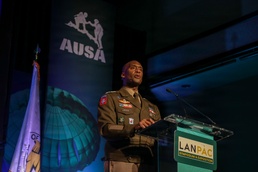
HONOLULU — Senior leaders from across the United Nations Command (UNC), Combined Forces Command (CFC), and United States Forces Korea (USFK), participated in the 2026 Land Forces (LANPAC) Symposium and Exposition on May 12-13.
LANPAC is a professional development event that brings together military leaders, government officials, and industry partners from across the globe. The annual forum offers service members the opportunity to engage with key decision-makers, share insights, and shape the future of integrated operations in the Indo-Pacific region.
From the opening keynote address to discussions on leaders fostering professional development and decision superiority, the Tri-Command leaders gave insights and shared their experiences to strengthen interoperability and discuss the future of readiness in the region.
U.S. Army Gen. Xavier T. Brunson, commander of UNC, CFC, and USFK delivered the keynote address on the first day of the LANPAC Symposium and Exposition annual forum. Brunson emphasized the importance of regional sustainment, industrial endurance, and allied integration in preserving peace an stability across the region.
"In this theater, sustainment is not the "tail"; it is the "teeth" of our deterrence," stated Brunson. "Together we demonstrate that strength, paired with collective readiness, is the ultimate guardian of peace...a true fortress for all our nations and interests here in the Indo-Pacific."
Brunson also held bilateral meetings with Maj. Gen. Rose King, chief of army of New Zealand, Maj. Gen. Chimedgochoo Tsogtjargal, commander of Mongolia Land Forces Command army, Gen. Masayoshi Arai, chief of staff of the Japan Ground Self Defense Forces, and Maj. Gen. J.R.S. Boivin, Canadian Army deputy commander.
U.S. Army Col. Matthew J. Skaggs, director of intelligence for UNC and USFK, and Deputy Director of Intelligence for CFC, participated in the decision superiority panel. The discussion focused on technology defining the next generation of leadership and explored how the military integrates emerging tech to maintain initiative in complex environments.
"In my mind, we need to get out of that old system centric architecture and move towards a data centric architecture, and that's how we win the fight and maintain data dominance," shared Skaggs.
U.S. Army Command Sgt. Maj. Robin M. Bolmer, UNC/CFC/USFK senior enlisted leader, participated in the senior enlisted leader panel, which focused on discussions about building relationships, integrating with the joint and coalition forces, and understanding the domain while continuing to develop and lead.
Regarding the senior non-commissioned officer's role in driving continuous transformation, Bolmer shared a few strategies that he believed NCOs could use to build partnerships to drive to collective transformation.
"Understanding the missions, capabilities, goals, and challenges of other organizations or allies is the first step in building and sustaining relationships that drive collective transformation," stated Bolmer.
He expressed the importance of not being able to discuss moving in the future, fighting in the future, or transforming without including partners.
"A method for achieving this understanding is consistent interaction through combined joint training events, unit engagement, and information sharing," said Bolmer. "These training events and engagements enable a leader to not only better understand the organization, but also provide opportunities to learn about one another."
Hosted by the Association of the United States Army (AUSA) and supported by U.S. Army Pacific, this year’s event featured dynamic panel discussions on the future of the U.S. Army in the Indo‑Pacific, interactive audience participation, and hands‑on demonstrations showcasing the latest defense technologies and services.
UNC, CFC, and USFK remain committed to maintaining a robust combined defense posture, strengthening alliances and partnerships, and working closely with regional counterparts to ensure peace and stability on the Korean Peninsula and throughout the Indo-Pacific.