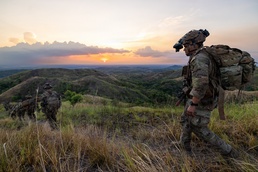
FORT MAGSAYSAY, Philippines — On May 8, the Joint Pacific Multinational Readiness Center-Exportable exercise shifted from planning to execution as Soldiers with 2nd Battalion, 21st Infantry Regiment, 3rd Mobile Brigade, 25th Infantry Division, moved into the rugged mountains of northern Luzon. Their advance marked the start of a complex operation focused on route reconnaissance in support of upcoming multinational missions.
This is JPMRC-X, a rigorous force-on-force training event that brings the U.S. Army’s premier combat training center experience directly to the Indo-Pacific. Serving as the second phase of the bilateral Exercise Salaknib, a word meaning “shield” in the local Ilocano dialect, the rotation strengthens the 25th Infantry Division and its partners’ ability to operate alongside allied forces in the Indo-Pacific environment.
Just two days later, on May 10, the focus shifted from the jungle to the sky. U.S. Soldiers, alongside members of the Australian and New Zealand armies, gathered in Laoag City to witness a complex Unmanned Aerial Systems swarm demonstration. This event highlighted the exercise’s theme of transformation, offering a critical look at the emerging, human-centered technologies shaping the future battlefield.
“Our alliance with the Philippines is steeped in history for over 75 years as the oldest treaty ally,” said Col. Adisa King, commander of the 3rd Mobile Brigade Combat Team, 25th Infantry Division. “What you are seeing here at JPMRC-X is the future of that alliance in action. We aren’t just rehearsing old tactics; we are rapidly integrating new technologies, such as UAS, alongside our multinational partners.”
Soldiers quickly put those new skills and systems into practice. On May 13, as Soldiers from the 2nd Battalion, 27th Infantry Regiment, 3rd Mobile Brigade, 25th Infantry Division pushed into their objectives near the municipality of Laur, they trained to identify and respond to enemy UAS threats. Infantrymen scanned the skies, identifying the sounds and movements of small UAS, providing critical early warning that enabled their platoons to engage and neutralize the threat.
“This exercise challenges us to be faster and increasingly capable and adaptable so that we remain a combat-credible force ready to outpace any adversary,” said King.
A grueling ground battle matched the fight for air superiority. Teams from Bravo Company, 2-27 IN, maneuvered through the challenging terrain, emplacing M224 60mm mortar systems and engaging opposing forces to secure their objectives. These platoon-level operations tested fieldcraft, unit readiness, and small-unit tactics under realistic conditions.
Simultaneously, the 25th Combat Aviation Brigade’s Task Force Saber extended the operational reach of the combined force, conducting complex CH-47 Chinook sling load operations to position Infantry Squad Vehicles into the battlespace rapidly.
This phase of the exercise demonstrated the interoperability required for multinational operations as U.S. and Philippine Army forces integrated capabilities across multiple domains.
“Training alongside the 25th Infantry Division during Salaknib allows us to harden our defenses and refine how we fight as a combined force,” said Col. Louie G. Dema-Ala, Chief Public Affairs, Philippine Army. “By sharing our deep knowledge of this terrain and integrating with the advanced technologies the U.S. brings to the fight, we are proving our shared commitment to defending our homeland and maintaining stability in the region.”
The multinational aspect of the exercise has been a consistent theme. Soldiers from Japan, Australia, and New Zealand have integrated into the planning and execution phases, providing a visible sign of the united commitment to regional security.
“Being here in the Philippines to train alongside both American and Filipino forces is an invaluable opportunity,” said MG Yanagi Hiroki, commanding general of the 12th Brigade, Eastern Army, Japan Ground Self-Defense Force. “It allows us to build the deep trust and mutual understanding necessary for multilateral cooperation. When we sweat together in this environment, we ensure that our nations can operate as one united front for a free and open Indo-Pacific.”
As JPMRC-X continues, the training will only intensify, culminating in massive, combined multi-domain exercises. From night reconnaissance to direct-action raids, every event is designed to build a force with greater capability, agility, and interoperability, prepared to respond to crises and contingencies across the Indo-Pacific.