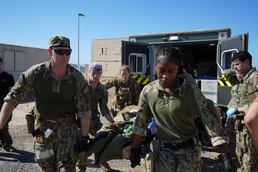
The U.S. Navy provides the combat credibility and persistent global presence that secures U.S. vital interests in contested environments around the globe. The health and readiness of every Sailor and Marine have become more critical than ever. Ensuring that our warfighters are medically prepared for the future isn’t just a supporting task; it’s a strategic imperative for the fleet.
In response to this urgent need, the Navy established the Navy Medicine Enterprise (NME) on Aug. 14, 2025. This transformative initiative represents stakeholders across the Navy to break down barriers and unify efforts. By providing a forum for senior fleet leaders to address and prioritize health services requirements, the NME provides the care to deliver a more lethal, efficient naval force to meet operational objectives.
Since 2016, there have been so many advances made in medicine and technology, that the character of war and what warfare will look like in the future, has changed accordingly,” said Lt. Cmdr. Luke Richmond, a plans, operations, and medical intelligence officer serving as the campaign order lead at U.S. Navy Bureau of Medicine and Surgery (BUMED). “In order to adapt to this and get ahead, we’ve changed the way that we solve problems, knowing that providing battlefield medical care in a resource-constrained environment will require more flexibility and reallocation of people and supplies than we’ve ever dealt with before.”
Over the last year and a half, the NME has established strategic priorities and built an operational framework, positioning the enterprise to shift its focus toward execution. The true measure of success now lies in turning decisions voted and approved by the NME Board of Directors into tangible improvements for Sailors across the fleet. Whether enhancing the limited duty and recovery process manning gaps, the NME is delivering real-world solutions for some of Navy’s most persistent health services challenges.
To support this transformation, the NME is focused on five primary Lines of Efforts (LOEs) summarized below:
Cmdr. Jason Fuchs, former NME Business Office director and current BUMED operations director, said, “We take the input from each of our LOE leads, and we’re able to design initiatives for the fleet based off their interests and guidance. From there, we can shape and track that information with data and analytics in order to bring tangible changes to Navy healthcare.”
The NME is moving beyond theory and into practice, delivering changes that are improving access to care and ensuring that the right medical personnel are in the right place at the right time, improving the well-being and readiness of the Navy and Marine Corps.
“The most important part of our En-Route Care Systems [ERCS] is that we need qualify corpsmen as EMTs [Emergency Medical Technician],” Fuchs explained. “Between the NME and the campaign order team, we broke down all of the different components and barriers. ‘How do we encourage corpsmen to obtain their EMT qualification? And then, how do we get them qualified as paramedics and make sure, they’re aligned to these platforms?”
In the high-stakes environment of modern naval warfare, medical readiness is mission readiness. Every member of the medical team, from the newest corpsman to the most senior officer, is critical to the success of the NME. The readiness of the Navy and the Marine Corps is being built right now – in clinics, on ships, with technological innovations, and through the efforts of every Sailor. By optimizing our most vital asset, the warfighter, the NME is ensuring that the Navy will not only be ready for the future fight but will win it.
Navy Medicine's 44,000+ talented and ready forces optimize health readiness, deliver quality healthcare, and provide global expeditionary medical support to warfighters from point of injury to higher roles of care.