JOINT BASE LANGLEY-EUSTIS, Va. -- The United State’s warfighting edge does not start on the battlefield. It starts with the fight against threats before they begin.
Antiterrorism sits at the heart of the U.S.’s National Defense Strategy, not as a background function, but as a driving force enabling warfighting excellence, deterring aggression and securing the homeland.
“Our [antiterrorism program] mission is to ensure the safety and security of our force, assets, personnel, resources and facilities through the aggressive application of antiterrorism and force protection measures,” said one 633d Air Base Wing Antiterrorism Program Manager (ATPM). “We aim to deter, detect, delay, deny and defend against any terrorist threats and or acts.”
According to the Department of War, terrorism is the unlawful use of violence or threat of violence, often motivated by religious, political or other ideological beliefs, to instill fear and coerce individuals, governments or societies in pursuit of terrorist goals.
At Joint Base Langley-Eustis, the 633d ABW installation commander maintains the ownership of the Antiterrorism Program, delegating mission execution to the 633d and 733d Security Forces commanders. They, in turn, rely on the ATPM to ensure mission success through critical functions such as: Vulnerability, Risk and Threat Assessments, Unit Antiterrorism Representative training and the implementation of Random Anti-terrorism Measures.
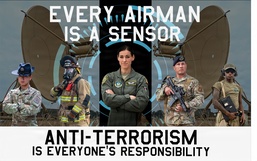
Antiterrorism is not confined to a single office or unit; it is a shared responsibility across the installation. It is every Airman’s job to help deter terrorism, ensuring security is not just an afterthought, but a constant priority.
“Base defense is a holistic responsibility; every member contributes to the mission by completing required ATFP training, reporting suspicious activity through the ‘See Something, Say Something’ protocol, and embracing the core Integrated Defense principle that every ‘Airman is a Sensor’,” said the ATPM.
According to the ATPM, misconceptions about terrorism can create dangerous gaps in awareness. It is not limited to high-profile locations or confined to any single cause or region. Threats can emerge anywhere. Preventing them requires vigilance at every level not just from law enforcement, but from every Airman.
Through consistent training and awareness, the Antiterrorism Program embeds deterrence into daily operations. It strengthens the installation from within, ensuring Airmen remain prepared, resilient and ready to execute their mission.
“The AT Program directly determines the installation’s survivability,” said the ATPM. “By effectively applying risk management, optimizing resources and synchronizing layered defenses, it hardens the installation against asymmetric threats, breaks adversary planning cycles and guarantees the continuous execution of mission-essential functions.”
In today’s evolving threat environment, readiness begins with prevention and every Airman plays a vital role in that mission.
For any suspicious activity or unusual occurrences observed, call 757-764-5091.