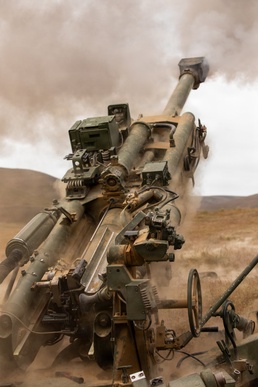
The article below was written by Don Carlucci, Senior Research Scientist for Computational Structural Modeling at the U.S. Army Combat Capabilities Development Command (DEVCOM) Armaments Center at Picatinny Arsenal, New Jersey. Other contributors include: Jeanne Brooks, Senior Scientific Technical Manager Large Caliber Cannon Systems and Technology; Christopher Stout, Supervisory General Engineer; Frank Fresconi III, Senior Research Scientist for Ballistics; Michael Minnicino II, Supervisory Mechanical Engineer at DEVCOM Army Research Lab; Shawn Dullen, Supervisory General Engineer; Elbert Caravaca, Competency Manager - Propulsion; and Edward Bauer, Senior Scientific Technical Manager Systems Engineering.
Why is cannon artillery important on the modern battlefield? Over the last few decades, range has become a major factor in the development of battlefield cannon and rocket artillery. For many years the Army was focused solely on precision in the artillery community with range being secondary. Once the precision guidance was achieved, first in the M982 Excalibur 155mm projectile in 2007 and then in Guided Multiple Launch Rocket System (GMLRS) in 2009, the focus shifted to range. Range is still important but the experiences in Nagorno-Karabakh, Ukraine, the Middle East and Southwest Asia have demonstrated that volume of fires, both offensive and defensive, is important. This volume of fires is, in turn, driven by magazine depth. Magazine depth has two components, volume and cost. Both of these point to the need for cannon artillery, although missiles and rockets still play a significant role. In addition to the need for cannon artillery in land systems, similar arguments can be made for cannon of larger than 6 or 8 inches on naval vessels. Before describing how rockets, missiles and cannon artillery can be used to the best advantage, it is useful to examine the strengths and weaknesses of each.
Range – The greatest advantage of rocket artillery is range. Rockets and missiles can reach out to very long ranges, much farther than cannon artillery. At these ranges, guidance is required in order to hit a target, which tends to be costly and makes them susceptible to enemy countermeasures.
Payload Size – The payload size of rockets and missiles is large in comparison to projectiles. These systems can carry larger numbers of submunitions to greater ranges than projectiles. This is a great disadvantage, however, in that a launcher can only carry a small number of them.
Mild Launch – The launch of a rocket or missile is mild in comparison to cannon artillery. These launch loads are measured in the hundreds of G’s rather than the tens of thousands that occur in a projectile. These mild launch loads allow the structure to be lighter and more submunitions to be carried as well as more fuel.
Size – Cannon projectiles are much smaller than rockets or missiles. Although the high explosive capacity of a single projectile is less, the small size makes them inherently less detectable than rockets or missiles, thus significantly harder to intercept. Additionally, this smaller size allows more projectiles to be stored in a given volume, easing the logistics burden associated with them and allowing more to reach the field.
Structural Robustness – Since a projectile is designed to survive its launch environment, they inherently are very strong structurally. Because of this property, they are more difficult to defeat with directed energy weapons and to some degree, kinetic ones. Often these projectiles are spinning which requires laser energy to be spread around the structure increasing dwell times. This, coupled with the ability to shoot many of them due to magazine depth and cost makes them a great alternative to clear a path that the rockets can fly through.
Penetration - Because a projectile is structurally robust they have the ability to penetrate armor via kinetic energy that rockets and missiles do not.
Accuracy – Projectiles are far more accurate than unguided rockets or missiles which allows them to be fired to fairly long ranges without guidance. Even when guidance is added, a projectiles inherent accuracy makes it cost less than 10% that of a missile, allowing many more to be purchased. This inherent accuracy also makes them more resistant to countermeasures and allows for several rounds to be fired at a target without worries of running short of ammunition.
Cost – One of the greatest advantages a projectile has over rockets and missiles is its lower cost. Unguided projectiles cost a fraction of a percent of a missiles cost while guided ones are a small percentage of the cost. As examples consider the guided Excalibur projectile which costs $68,000.00, while a guided MLRS rocket costs $170,000.00, and a unguided M795 high explosive projectile costs $820.00
Flexibility – The small size of projectiles allows several different types to be carried allowing for different missions to be performed at a moments notice. Rockets and missiles are placed in their launch pods at the factory and thus cannot be altered in the field. So if a unit in contact with the enemy needs a smoke mission instead of a High-explosive mission, or needs to lay a hasty minefield or fire submunitions, the rocket launcher cannot support it.
Given all of these advantages and disadvantages, one can see that for very long range targets, rocket and missile systems excel. These targets must be worth the cost of firing one of these munitions but the target will be reached and, if the layered defenses are successfully navigated, neutralized. For short range targets, or targets where area effects are required, cannon artillery offers the most cost effective solution. Since a single rocket contains more munitions or explosive, expending one of these expensive “birds” on a lower cost target, even though it should defeat it, is a waste of their true capability and a needless depletion of an already limited magazine. With cannon artillery, the right amount of ammunition can be used to service the target without “overkill” and needless depletion of the magazine. Since many rockets and missiles are more susceptible to countermeasures, the cheaper cannon projectiles can be used to defeat countermeasures along the flight path of the missiles, essentially creating a lane through which they can be reliably fired enabling them to use their deep attack capability more effectively and allowing fewer to be fired. In a defensive mode, projectiles can be fired at a high rate at a larger number of targets, forcing “swarming” tactics to be more difficult for the opponent and avoiding the expenditure of an extremely expensive missile on a far cheaper threat. Finally, if battlefield preparation is necessary, cannon artillery can saturate the landscape at a fraction of the cost of a missile system. In summary, the strengths of missile systems are exploited by using them against long range targets of high value, both in an offensive role or defensive role. Cannon artillery is needed for all of the other missions with rockets or missiles only being used if cannon are not available.
Why is engineering knowledge required to accelerate development? Historically, cannon, rocket and missile systems have spent 20 or so years in development. So one should ask “why does it take 20 years to develop a new weapon system when a car can go from concept to production in about 2-5 years [1]?” Fundamentally, efficient design of a system is all about understanding the operating environment. In the design of an automobile, the designers fully understand the simple operating environment the vehicle will see, from the temperatures it will experience over its lifetime to the vibrations induced by road conditions. All of this material is documented in common standards or their own databases. In the design of a large caliber cannon, the gun, the projectile, and the propellant charge interact in a complex way that is extremely aggressive, nonlinear and non-intuitive. One cannot separate the design of one from the other and expect good results. A great amount of research has permitted the detailed understanding of the projectile’s hypervelocity flight in the atmosphere which has resulted in the ability to quickly design them to meet their aerodynamic requirements with extremely accurate simulations. The same is true for terminal ballistics where the penetration of the target by the munition is largely understood due to a dearth of research and the application of statistical probabilities. It is the interior ballistic behavior, the ignition and subsequent combustion of propellant, along with its dependence on the motion of the projectile as it traverses the length of the gun tube that is less understood. Interior ballistics is characterized by aggressive mechanical, extreme thermal, and complex chemical interactions that are difficult to nail down predictively and have marked variability, due to a variety of sources related to propellant, ignition, flame spreading, ullage, etc. These interactions are not understood in sufficient detail to allow a weapon system to be designed and fielded on the same time scale as a car. Combined, the extreme and complex interactions combined with marked variability make it difficult to accurately simulate the interior ballistic behavior and therefore also makes design engineering challenging. Furthermore, there is limited analogous physics in other commercial spaces where advancements might be leveraged to further our understanding of interior ballistics. Rockets and missiles have commercial applications for satellite communications and space exploration. This doesn’t exist for large and medium caliber cannon. Small arms gun manufacturers are a commercial application, but in this case, experimentation is fast because the prototypes are cheap. If the gaps mentioned above were better understood, the time to fielding would be significantly reduced. Regardless of these challenges, these gaps can be closed with deliberate and purposeful research focused on developing scientific understanding and key insights which is in contrast to the expedient development of a system for an acquisition program with short and firm schedules and milestones which often preclude scientific excursions and discovery.
We have been designing these systems for hundreds of years, so a logical follow on question might be “how have done this in the past without the understanding described above?” The reality is that the government and contractor engineers are extremely good at improvisation. Once a program gets started, engineers take the best educated guess they can to build something and begin testing. They make design modifications as they make discoveries along the way, and they test again. It has been the same way for hundreds of years, though now computers have sped things up a little – particularly for aerodynamics and terminal effects technology areas as described above. The design of the interior ballistic system, composed of the gun and propulsion charge, is largely experimentally driven and uses modeling to learn trends in behavior to gain insight not achievable through testing and to better direct system design modifications . AI won’t help much because the training data is just not there or inconsistently and sparsely parameterized for machine learning.
Over the past several decades, computing power has increased significantly and as a consequence modeling and simulation technologies have also advanced significantly. However, not all weapon technical areas have seen the same amount of advancement due to a variety of reasons, the largest being lack of perceived need. Historically, the development of advanced modeling and simulation tools were a high-risk without the high-reward endeavor due to the evolutionary nature of weapon fielding. This is particularly true for interior ballistics modeling where the employed simulation tools provided the level of fidelity needed to develop a working system – albeit with a significant amount testing. Additionally, the high risk and costly development of these tools are the primary reason that private sector has not invested. Further, the education and level of skill in employing these advanced simulation tools is considerable and can be beyond the private sector threshold. Today, however, modern weapon development is no longer evolutionary due to subtle but critical changes in design driven by capability requirements and these subtle changes have resulted in the current array of interior ballistic simulation tools to become insufficient and our experimental techniques unable to provide the critical insights needed to clearly resolve design problems and optimize performance. This lack in investment has limited our ability to collect high quality data and validate models in the unique and highly aggressive firing environments weapon systems must endure. Although our federal civilian subject matter experts are using the tools that are available and performing this work, it is completed as necessary for individual program needs and not collected and disseminated to the industrial partners who need it.
The long development time is not only due to design and engineering issues. A sizable portion of the development time is often due to long lead times in getting material and fabrication (often contracted to do in the private sector). For example, continuing with the large caliber gun example, new propellant delivery takes 12 to 18 months to deliver. This drives the need to be able to accurately model the weapon interior ballistics as being able to replicate firing environments in a simulated environment will increase the speed of development dramatically.
What steps can we take to acquire this engineering knowledge? We need to invest in systematic and sustained research into the physics of the problems. Unfortunately, with all of the current focus on speed, this is being neglected and it is vital for success. A serious challenge that currently faces our procurement establishment is the proliferation of concepts that are ignorant of the physics. While innovation and new ideas are essential to developing our armed forces, the physical understanding enables these concepts to quickly transition. One without the other simply will not work. We can have both and the result will be faster system deliveries.
A critical reason for the “Valley of Death” in programs is that the problem being solved is not fully understood. This is in large part due to inadequate funding ate the 6.2 and 6.3 level. The programs get pushed, without sufficient investment, into production where it is expected that a manufacturing line will be stood up and systems produced. In reality, all of the unknowns that were still present when the program was “transitioned” now have to be solved at the same time as the manufacturing line is being set up. This used to be accepted because the lion’s share of the funding wasn’t available until the transition occurred. The price that was paid was time and money.
Investments in physical understanding by the government is extremely useful since it can be passed to all potential companies that propose weapon systems.
Modeling tools are a key component of shortening the timeline. Once the physical understanding is obtained, it will need to be incorporated into models. All modern weapons are now designed with these tools. Arguably, they cannot be designed without them any more. Time and again these models prove that they can determine how to fix a problem. Without the suggested physical understanding above, they will continue to be used for successful failure investigations instead of design predictions to avoid the failures.
Once the physical understanding is established and incorporated into models, designs can be rapidly constructed and delivered to field units for experimentation. If successful, the units can then concentrate on how to employ the system more effectively or what additional design features they would like rather than having items break or not work as intended. A digital design that functions properly is much easier to modify than one where significant fixes are required just to allow it to be used in an experiment.
With fundamental understanding in hand, off-the-shelf technologies become accessible. The understanding of the launch environment, for example, will enable engineers to quickly determine how much, if any, modifications are necessary to commercial items to allow them to function effectively on the battlefield. A good example of this is the modification of a commercial truck to carry a 155mm howitzer. Some fairly straightforward modifications are required in this case, where the weapon experts in the Government can provide loads to the commercial truck manufacturers and have a system delivered very quickly. It could then be used in experiments without any fundamental design issues appearing. Another example would be taking a commercial optical system and hardening it to be used in a gun or missile. With proper understanding of the loads, it is possible to integrate commercial systems at lower cost into weapons.
How does this engineering knowledge help accelerate other systems across the War Department? There are many areas that the acquisition of the engineering knowledge described above will help accelerate other efforts withing the War Department. The underlying physics that is discovered can benefit the rocket and missile community as well. Rocket motor structural properties that are so necessary in gun launched, rocket assisted projectiles will directly inform rocket and missile designers about how these materials behave under proper loading as well as insult. This is critical to determining how vulnerable a missile system is to attack in addition to supporting the design more reliable systems through modeling. The ignition of propellants is identical, if not similar to ignition is rockets, missiles and small arms. An understanding of this area can result in faster response times for missiles and even use of the propellant as a warhead, increasing range and/or reducing size. Advances in dynamic modeling will directly improve the rocket and missile simulations too.
Acquiring a fundamental understanding of the phenomena involved in gun launch will allow the Government to assist our contractors in delivering outstanding weapon systems at a pace commensurate, and possibly faster than, the automotive industry, taking a 20 year process down to 2-5 years. Since cannon artillery is such a critical part of the modern and future battlefield, this understanding is essential to realize the rapid fielding times currently being promised by industry and Government alike. If the physics described above is not understood, we can expect many promises to remain unfulfilled.
References: [1] Sabadka, D., Molnar, V., Fedorko, G., Shortening of Life Cycle and Complexity Impact on the Automotive Industry, http://www.temjournal.com, 30 November 2019.