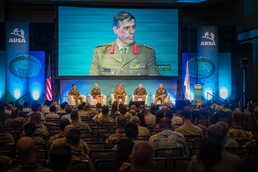
HONOLULU — Land Forces of the Pacific Symposium and Exposition panelists shared insight on how all Army components across the U.S. Indo-Pacific Command blueprint is adapting to the contemporary environment alongside allied nations and partners during LANPAC 2026 on May 14, 2026, at the Sheraton Waikiki Beach Resort in Honolulu, Hawaii.
The panel focused on how Army components are working together to meet challenges across the Indo-Pacific region while strengthening partnerships with allied and partner nations. Leaders highlighted the importance of readiness, modernization, and interoperability as the region continues to play a central role in U.S. defense strategy.
Panelists discussed how their respective Armies are adapting to emerging threats, including long-range missile systems, cyber warfare, and rapidly advancing technology. The discussion also emphasized the need for active-duty, reserve, and National Guard forces to remain flexible and capable of operating together during large-scale operations and multinational exercises.
“We're seeking to take home ground advantage from living and being present in our communities,” said Brigadier Mark Armstrong, deputy commander for the 2nd Australian Division.
“We seek to leverage the skills within our reserve workforce, which come from all walks of society. We need to have key relationships with our local, state, and federal government, with industry, and with our communities. So we've had a series of initiatives in order to further that, to develop that home ground advantage.”
Throughout the discussion, leaders explained how each Army component contributes unique capabilities to the overall force. Active-duty units provide forward presence and rapid response capabilities, while reserve and National Guard forces continue to expand their operational roles in sustainment, logistics, homeland defense, and joint operations.
“When the theater army needs critical capabilities, the 9th MSC can provide,” said Brig. Gen. Katherine Trombley, commanding general of the 9th Mission Support Command. “They are ready to go forward. I don't need to get them from CONUS; I don't need to coordinate transportation. We can respond immediately and provide support to the theater army when we are called.”
The conversation reflected the Army’s broader effort to transform for future conflicts while maintaining readiness for current missions. Leaders discussed modernization initiatives that include integrated air and missile defense systems, data-driven operations, and improved coordination across multiple domains.
The panel additionally addressed challenges facing the force, including recruiting, retention, and maintaining operational tempo across geographically dispersed areas of responsibility. Speakers noted that adapting to the contemporary environment requires not only technological advancement, but also investment in Soldiers and leader development.
“We call these Soldiers back once a year for up to two weeks to update them on their skills and evaluate them on their competencies,” said Col. Dean Yik, head of the Singapore National Service Affairs Department. “This allows us to have a rather large army sustained by the citizens.”
LANPAC 2026 brought together military leaders, government officials, and defense industry representatives from across the Indo-Pacific region to discuss land power cooperation, security challenges, and future operational concepts.