NORTH LAS VEGAS, Nev. — Hidden for decades beneath the soil of a Cambodian knoll, a small, weathered metal disc silently held the weight of half a century of grief, love and unanswered questions.
For 56 years, the word “missing” hung heavy and undefined in the lives of the Huberth family. It was a void left by a son and brother. May 13, 2026, exactly 56 years to the day since his aircraft vanished during a combat mission, a tangible piece of U.S. Air Force Capt. Eric “Rick” Huberth finally came home.
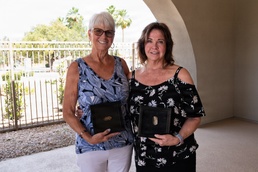
Lt. Col. Brittany Lee, 99th Force Support Squadron commander, presented Capt. Huberth’s recovered ID tags to his surviving sisters during a solemn ceremony, offering a long-awaited physical connection to a hero they never forgot.
As an F-4D Phantom II weapon systems officer, Capt. Huberth was declared missing in action May 13, 1970. Since then, Capt. Huberth’s family -- his mother and four sisters -- have anxiously awaited news of their loved one.
Decades of search and 11 excavations of the crash site by recovery teams, including the Defense POW/MIA Accounting Agency and Ohio Valley Archaeology, INC., finally led to the poignant discovery of his ID tags, commonly known as dog tags.
To the Air Force, he was a dedicated aviator and officer. To his family, he was simply Rick. He was the young man who bought his sisters their first cars, quietly paid his mother's utility bills and served as a loving role model. He was, as his sister Lorraine Larson remembers, the glue that held them together.
“He was our father figure,” Larson said. “I mean, I'm not saying that he wasn't a pain in the neck, but he did a lot of things he didn’t have to do. And I know for a fact that if there is some way that he could have made more money, on different missions and whatever he was doing, he would have done it for my mom.”
Leading up to that fateful afternoon in 1970, Capt. Huberth had flown 55 missions in six weeks. During his last flight, then-1st Lt. Huberth and his pilot, Capt. Alan R. Trent, were on an interdiction mission to destroy a bridge along the Ho Chi Minh Trail in Cambodia. After the lead aircraft missed the target, Capt. Huberth and Trent’s F-4D was hit by enemy ground fire. Trent attempted to abruptly pull the aircraft up before impacting a knoll and two ridgelines.
Both men were listed as missing in action. For the families left behind, the uncertainty was a unique and terrible burden.
“He was the backbone of the family,” Larson said. “And then, all of the sudden it's like the rug was pulled out from under us. I’m 16 years old and he's missing. It would have been easier for our family if we were told he was killed. At the time, it was like, ‘Oh, if he is missing, that means he's just missing. He's coming home.’ ... I honestly didn't really embrace it because he's always been around. I never doubted for one minute that he wasn't coming home.”
The decades that followed were filled with waiting and anguish. Initial searches yielded little. Only in April 2026 did an excavation finally reveal not just a personal possession, but a form of identification that would have been physically carried by Capt. Huberth.
“The desire to know and be known has always been a deeply human characteristic,” said Jim Flook, historian for the 99th Air Base Wing. “When one’s life was at risk, the desire becomes more poignant. The familiar standardization came about in World War II: a rounded rectangle with a notch, bearing name, rank, service number, blood type, and the optional religious identification. While the style changed [over time], the intent remained steadfast. The dog tag is the desire to be known. The dog tag is our nation’s commitment to our service members to leave none behind.”
For Larson and her sister, Suzanne Huberth, receiving the tag is a moment of profound, if incomplete, healing. As the remaining surviving family members, it validates their 56-year fight to honor his memory and provides a sense of peace that has long been elusive.
“This is such an incredible moment for our family to have closure,” Larson said. “It is closure. It's not complete closure. But for me personally, it's something more than we've ever had in 56 years.”
The search for complete closure continues. With one final excavation of the crash site scheduled for January 2027, Larson and Ms. Huberth hold onto the hope of bringing their brother home. Their ultimate goal is to recover Capt. Huberth’s remains and honor his life, service, and sacrifice with a proper burial at Arlington National Cemetery, Virginia.
The return of Capt. Huberth’s ID tags is a testament to the Air Force’s unwavering commitment to its people, ensuring the passage of time does not erase the sacrifices of those who served.
"Leave no Airman behind" is far more than just a motto. It is a sacred, enduring promise that does not expire. Not even after 56 years.