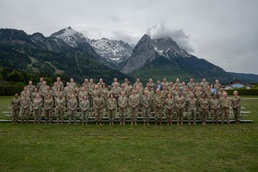
U.S. Air Force medical leaders gathered in Garmisch 4-8 May, 2026, for the U.S. Air Forces in Europe – Air Forces Africa Surgeon General annual tabletop exercise.
Senior leadership joined medical group command teams to equip and plan for operational contingencies through tabletop discussion forum communicating scenarios in a controlled setting to identify gaps, align planning and build a common operational picture.
This tabletop exercise serves as a precursor to larger operational field exercises, giving senior leaders and medical group commanders a shared framework before moving to live training with international partners across the European theater.
Ensuring group leaders have direct access to senior leadership is pivotal in the service's medical field to save lives quickly and effectively.
This year's tabletop exercise welcomed distinguished visitors including U.S. Air Force Lt. Gen. John J. DeGoes, Air Force and Space Force surgeon general, and U.S. Air Force Maj. Gen. Jeannine M. Ryder, Medical Readiness Command-Bravo commander and Defense Health Network-Continental director.
Now in its fourth year, the exercise was hosted by U.S. Air Force Col. Thomas Stamp, USAFE-AFAFRICA command surgeon, and brought together command teams from all eight military treatment facilities across Europe.
"Our goal is to sync with U.S. European Command across the joint force so we can provide the EUCOM commander with the best options from a medical standpoint," Stamp said. "We are accomplishing the mission of fighting tonight, fighting tomorrow and fighting together."
The exercise is built around three core objectives: building a shared understanding of each facility's capabilities across the theater, helping medical group teams understand their individual role in a larger fight and providing an opportunity to advocate for resources and policy changes directly to senior leadership.
"The third piece, which is really aimed at our distinguished visitors, is an opportunity for us to bring challenges and the opportunity for advocacy," Stamp said. "To help senior leaders understand why this theater has some advantages and disadvantages, so that they can provide us with resources where we need it."
DeGoes used the exercise to take in operational concerns directly from medical group commanders and assess where U.S. Air Force headquarters can better support the theater.
"I'm looking at it from how we best support our forces in Europe and to see what the issues are operationally," DeGoes said. "The Air Force Medical Service is in the process of standing up Air Force Medical Command, and that transition would eventually include USAFE's medical groups."
The exercise pushed leaders to think about how care delivery would change in a contested war environment, where dispersed operations and evolving threats are reshaping how medics operate.
"How do you prepare medically for that environment?" DeGoes said. "How do we have our medics deliver the same amount of care while also making sure they are safe to execute their mission in that kind of newer threat environment?"
Throughout the event, scenarios were built around a fast-moving European conflict where medical teams would have minimal lead time and finite resources to work with. Each group walked through what they could realistically accomplish in a potential conflict, accounting for personnel, equipment, training limitations and the competing day to day demands of caring for their installation populations.
"If we were to enter a conflict on the European continent, it would probably happen with very little forewarning and require a very fast reaction," Stamp said. "The exercise forces teams to make decisions under pressure, with competing demands and finite resources."
U.S. Navy Capt. Wayne Smith, U.S. European Command surgeon, was invited to offer participants a joint force perspective. Smith attended to share how the combatant command thinks about medical planning, what the command expects from the air component in a contingency and where the joint force needs to be aligned ahead of any operation.
"We operate and fight as a joint force, and it's not easy,” Smith said. “It takes a lot of effort because there are very unique cultures and capabilities, and we sometimes speak different languages."
Both the Navy and Air Force benefit from these exchanges, with the relationships built well before an operation, often becoming the foundation of how the services work together in a contingency.
"No plan survives first contact, it's the planning process," Smith said. "These exercises foster relationships among the team through communication, collaboration and the exchange of ideas. You have to be willing to get uncomfortable, and that's truly the real power of collaboration."