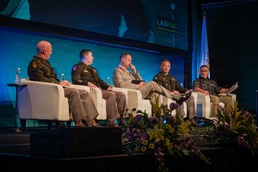
HONOLULU – Military leaders and defense experts at the 2026 Land Forces Pacific Symposium and Exposition discussed how joint partnerships are accelerating rapid change, May 13, emphasizing the growing importance of continuous transformation in increasingly complex operational environments.
"It's more than what we put on a coin or on a bumper sticker. It's the reality of how we go together with our Korean allies," said Lt. Gen. Joseph Hilbert, commanding general of Eighth Army in Korea.
For decades, military advantage relied primarily on building better individual platforms and faster weapons. Today, that advantage is shifting toward interoperability, the ability of coalition forces to share data, establish regional sustainment hubs, and adapt faster across all domains.
This shift is essential because modern military environments require immediate strategic flexibility. The current operational challenge is ensuring that a highly trained force can rapidly deploy into a theater, such as the first island chain, and fall in on pre-positioned equipment sets seamlessly.
”We talk about relationships as a pacing item; the pacing piece of equipment is the most important piece of equipment in a formation," said Maj. Gen. James Dooghan, commanding general of U.S. Army Japan.
"And for everything that we talked about, the relationship is the pacing item that requires investments, " said Dooghan. “It requires maintenance, and it requires initiative.”
“This rapid evolution is driven by three key trends,” said Dooghan. “First, forces are shifting toward continuous, complex multi-domain exercises worldwide to strengthen deterrence. Second, technical interoperability depends on trust and effective data sharing. Finally, leaders must constantly evaluate personnel, capabilities, and authorities to operate at the speed of relevance.”
A modern, integrated land power network is required to deploy these combined capabilities effectively. Where there is trust, there is accountability, allowing partner nations to push each other to improve readiness and operate in the right space.
The modernization efforts, however, require a broader coalition. Close collaboration with international partners and technology companies ensures that the joint force can leverage new innovations in a timely manner.
As Maj. Gen. Ollie Kingsbury, Director Land Warfare for the United Kingdom, mentioned, “One of the critical things to make that work is partnerships. And if you can't rely on the people around you, whether it's readiness now or it's transformation modernization, then things will fall apart very quickly.“
The military’s approach to modernization is multifaceted, encompassing joint training, technical interoperability, and deep allied relationships. By prioritizing continuous transformation alongside partners, the armed forces are positioning themselves to outpace adversaries and remain ready to defeat aggression.
"We've got to be investors in new thought, and we've got to be instigators of new thought in the way that we transform," said Lt. Gen. Joseph Hilbert, commanding general of Eighth Army in Korea.
LANPAC 2026 continues throughout the week with discussions focused on strengthening partnerships, advancing innovation, and improving integrated land operations across the United States Indo-Pacific Command area of responsibility.