FORT BLISS, Texas — Soldiers assigned to 4th Battalion, 6th Infantry Regiment, 3rd Armored Brigade Combat Team, 1st Armored Division, drew attention across the armored force after achieving high scores during gunnery qualifications, validating the Army’s updated standards and reinforcing disciplined, standards-based training.
Maj. Gen. Curtis Taylor, commanding general of the division, described the battalion’s performance as a model for armored formations across the Army.
“What this battalion achieved is unprecedented in the recent experience of combined arms battalions across the Army,” Taylor said during the distinguished and superior crew recognition ceremony. “You showed the Army what a standards-based organization can achieve. You showed the Army what happens when we empower noncommissioned officers and unleash the incredible potential inside our formations to build lethal crews.”
The ceremony recognized crews who exceeded Army qualification standards during Table VI gunnery. Distinguished crews scored above 900 points while qualifying on nine out of 10 engagements. Superior crews scored above 800 points while qualifying on at least eight out of 10 engagements.
Taylor credited the battalion’s success with ending discussions questioning whether the Army’s updated [Training Circular 3-20.31-120 and Training Circular 3-20.31-25] gunnery standards set the bar too high.
“Everybody across the Army is saying, ‘Do it the way 4-6 Infantry did it,’” Taylor remarked. “That’s the standard you all set.”
Division leaders credited the achievement to disciplined maintenance, deliberate repetitions and crew-level proficiency throughout every phase of training.
Master Sgt. Anthony Schulz, the division Abrams master gunner, emphasized that the crews exceeded Army standards by a substantial margin.
“The Army standard is 700 points with seven out of 10 qualified engagements; 70 points per target,” Schulz explained. “These crews didn’t just meet the standard, they exceeded it. That represents lethality, precision and mastery of the platform.”
Schulz noted the training directly translates to battlefield readiness.
“This is the foundation of lethality for armored crews,” Schulz stated. “When Soldiers can identify, engage and destroy targets under pressure, they prove they are ready for combat operations in real-world conditions.”
Capt. Gray Hansen, commander of Comanche Company, attributed the results to months of preparation following the battalion’s return from Bulgaria in 2025.
Leaders immediately focused on the Army’s newly published [TC] standards by conducting tank commander certification courses, simulator repetitions, gunnery skills testing and collective crew rehearsals before live-fire qualification.
“We attacked the fundamentals early and built repetition into every phase of training,” Hansen recalled. “From Gunnery Skills Testing to simulators to live-fire rehearsals, every crewmember became proficient at every station inside the tank. That created confident and lethal crews capable of performing under pressure.”
Hansen stressed that successful gunnery requires more than marksmanship.
“It’s not just about how you perform on the range,” Hansen added. “It’s about the maintenance, preparation and discipline that happens beforehand. Our crews want to shoot on their own tanks because they know their vehicles, they trust their equipment and they understand how their platforms perform.”
Among the Soldiers recognized was Staff Sgt. Logan McCormick, a tank commander whose crew earned a distinguished rating with a score of 912 points with qualifications on all 10 engagements.
Crews completed multiple gates of training before qualifying on Table VI, including gunnery skills testing, simulator certifications, dry-fire rehearsals and live-fire practice tables.
“With the new TC, the standard is clearly defined,” McCormick explained. “Success comes down to studying the manual, rehearsing as a crew and mastering every engagement before you ever get to the range.”
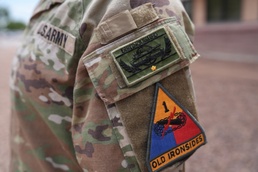
The ceremony also introduced a newly designed Gunnery Patch the division created to recognizing distinguished and superior crews. Distinguished crews receive a gold star while superior crews receive a black star. Soldiers may wear the patch for one year following qualification, with additional stars added for repeated distinguished or superior performances throughout their careers.
Taylor described the patch as a symbol of professional excellence within the armored force and recognition for crews who mastered one of the Army’s most demanding combat tasks.
“When the moment comes, you can get out there, destroy targets and do exactly what that equipment was designed to do,” Taylor said. “You earned the respect of this division because you proved yourselves masters of your profession.”
Division leaders noted the recognition program could expand beyond the division and become standardized throughout III Armored Corps and the Army, reinforcing a culture centered on lethality, standards and combat readiness.