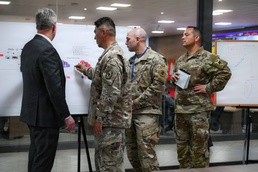
AGADIR, Morocco — U.S. Africa Command accelerated battlefield innovation through the integration of the Mobile Ad Hoc Network–Cloud High Mobility Radio system during African Lion 26, the largest multinational exercise held in Africa, April 20-May 8.
By bridging critical communication gaps between industry capabilities and operational forces, MCHMR (pronounced “MC Hammer”) reshapes how data moves, processes and drives decisions across the joint and combined force.
“We identified a critical gap [of] no unified pathway to integrate industry-provided data, from geolocation to full-motion video, into our operational systems,” said U.S. Army Lt. Col. Ramon N. Leonguerrero, African Lion future operations chief, chief of fires, and innovation division project manager for U.S. Army Southern European Task Force, Africa (SETAF-AF). “MCHMR solved that problem by creating a streamlined information pathway that connects the tactical edge directly to the combined joint task force headquarters through a shared common operational picture.”
Through MCHMR, allied and partner nations participating in AL26 accessed and contributed to a shared common operational picture, significantly improving interoperability and collective decision making.
“AL26 integrates readiness, lethality and innovation by placing emerging technologies directly in the hands of the warfighter alongside our allies and partners,” said U.S. Army Brig. Gen. Daniel L. Cederman, deputy commanding general–reserve, SETAF-AF. “By testing and refining these capabilities in a multinational environment, we are strengthening interoperability and ensuring we are prepared to meet evolving threats.”
This convergence drove the rapid fielding and refinement of systems like MCHMR, turning experimentation into operational advantage.
“MCHMR integrates operational and tactical sensor data across the formation, ensuring leaders at every level have access to comprehensive, real-time information,” Leonguerrero said. “That connectivity enables faster, more informed decisions in complex environments.”
MCHMR directly supports USAFRICOM’s priorities to strengthen partner capacity and operational effectiveness throughout the theater.
“We are enhancing partner integration into the common operational picture by leveraging a hardware-agnostic platform that can securely share diverse data types across multiple partners,” said U.S. Army Chief Warrant Officer 4 Bryan G. Duncan, J6 chief technical advisor for U.S. Africa Command. “Our focus is on building resilient data pathways that enable seamless collaboration in both connected and disconnected environments, ultimately empowering decision dominance at the tactical edge.”
Several first-of-their-kind achievements during AL26 underscored the system’s impact.
“In a breakthrough for coalition communication, USAFRICOM, in coordination with SETAF-AF, validated a multilanguage artificial intelligence capability that delivers real-time, Arabic-to-English translation over MPU5 radios integrated into the MCHMR network,” Leonguerrero said. “This advancement reduces reliance on human translators and enables faster, clearer communication during multinational operations.”
Building on this advancement, the system also expanded how coalition partners share and access real-time intelligence.
“In another milestone, the innovation team successfully integrated Moroccan 'WanderB' unmanned aerial system feeds into the MCHMR cloud environment and next-generation command and control systems, marking the first time partner-nation intelligence, surveillance and reconnaissance data has been directly shared across the network,” Leonguerrero said. “The integration allows full-motion video to move from ground control stations to CJTF operations centers and connected end-user devices, enhancing shared situational awareness across the coalition.”
At the tactical level, joint service members directly enabled these capabilities by integrating hardware and systems across multiple nations in real time.
“We’re integrating MPU5 radios with multiple U.S. and partner systems, including unmanned aerial platforms, to push real-time data across different networks and classification levels,” said U.S. Air Force Airman 1st Class Caleb Hilton, a radio frequency transmission operations specialist for 355th Communications Squadron, 355th Mission Support Group, 355th Wing. “This is the first time we’ve successfully tested real-time, Arabic-to-English translation on these systems, and seeing different services and nations work seamlessly together to make that happen has been a huge step forward.”
This expanded data-sharing capability sets the conditions for further advancements in C2 integration.
“Additionally, following an intensive six-day development cycle, the team achieved the first integration of full-motion video into next-generation C2 systems operating on Non-classified Internet Protocol Router Network architecture within the USAFRICOM area of responsibility,” Leonguerrero said. “This capability provides critical support for target identification and battle damage assessment, accelerating the decision-making process.”
Together, these innovations highlighted the rapid pace at which new capabilities are developed and fielded in a live training environment.
“African Lion demonstrates that service members can rapidly adopt and employ emerging technologies,” Leonguerrero said. “Through iterative cycles of testing, failing, fixing and validating, we are delivering capabilities at the pace modern warfare demands.”
Rather than relying on traditional acquisition timelines, these efforts emphasized rapid experimentation and immediate operational feedback to refine capabilities in real time.
“USAFRICOM and SETAF-AF drive meaningful, cost-efficient innovation for the joint and combined force,” Leonguerrero added. “We integrate artificial intelligence, robotics and next-generation digital technologies to dominate today’s complex challenges. Our purpose is to translate vision into battlefield-ready capabilities that are intuitive, scalable and immediately impactful.”
MCHMR carried AL26’s momentum forward, enabling integrated, data-driven operations that will define future coalition success.