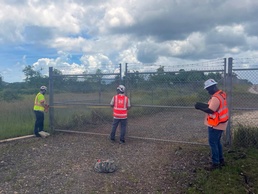
CONCORD, Mass. - Capt. Stephen O’Brien of the U.S. Army Corps of Engineers, New England District, recently returned from a six-week deployment to Guam, where he supported engineering design efforts that benefit both U.S. military operations and the island’s residents.
Guam, a U.S. territory in Micronesia in the Western Pacific, hosts multiple military installations alongside a growing civilian population. O’Brien deployed at the end of January as part of a Forward Engineer Support Team (FEST) and returned in late March.
“The FEST is a team within the Corps of Engineers that deploys for a period of six months that supports the entire Department of War,” said O’Brien. “Not just the Army, but the Air Force, the Marine Corps, the Navy and any other assets that require technical engineering design.”
O’Brien served as officer in charge, working alongside a Navy chief petty officer. Their team included six civilian specialists across multiple disciplines.
“We had a civil engineer, an environmental engineer, a cost estimator, a mechanical engineer, a geotechnical specialist, and an electrical engineer,” he said.
His primary responsibility was to gather requirements from stakeholders and guide the team in producing design concepts for a range of projects. This required balancing competing needs among Navy, Marine Corps, and Air Force installations while coordinating with local government authorities that control land use.
Despite the strong military presence, much of the team’s work focused on civil infrastructure.
“The FEST mostly worked civil works such as beach improvement projects for Guam aimed at reducing beach erosion,” he said. “Projects included everything from building infrastructure to support the population in Guam and to support the military bases there.”
O’Brien joined the team during its final six weeks but contributed to a mission that delivered significant results.
“I came in late, just wrapping up the last six weeks. The rest of the team was there for six months,” he said. “While they were there, they completed 18 projects valued at around $400 million. This was a very quick turnaround for six months for a small team to do that much work.”
He said the deployment offered both professional impact and personal experience, including travel within the region.
O’Brien emphasized that FEST opportunities are open to a wide range of USACE employees.
“I think a lot of USACE employees don’t know about FEST,” he said. “Any USACE civilian can join. You get paid to go to see places like Europe, the Pacific, South America, or wherever the Department of War needs the FEST and make a real impact. “
Team members often expand their skills by working outside their primary disciplines.
“We had the mechanical engineer and the electrical engineer trading work,” he said “Our geotech increased his skill set a lot by helping out civil and helping out mechanical. “
While acknowledging the challenges of deployment, O’Brien strongly recommends the experience.
“Six months is hard to be away from family and your projects,” he said. “But it’s a great opportunity to work outside your comfort zone and grow professionally.”
“It’s a chance to have a huge impact outside of your District and your region,” he said.
O’Brien has served with the New England District’s Construction Division for nearly a year and is currently a project engineer with the Devens Resident Office.