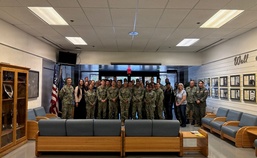
RIDGECREST, Calif. — Capt. Janiese Cleckley, commanding officer (CO) of Navy Medicine Readiness and Training Command (NMRTC) Twentynine Palms and director of Naval Hospital Twentynine Palms (NHTP), visited Navy Medicine Readiness and Training Unit (NMRTU) China Lake and Branch Health Clinic China Lake April 28, 2026, alongside Master Chief Richard Moreno, command master chief (CMC) of NMRTC Twentynine Palms and senior enlisted leader for NHTP, during a quarterly leadership engagement focused on operational readiness, staff development, patient care, and alignment with broader Navy Medicine and Defense Health Agency priorities.
The visit included an all-hands call, discussions with Sailors and civilian staff, recognition of high-performing personnel, and a walkthrough of the clinic led by NMRTU China Lake officer-in-charge Cmdr. William “PJ” Martin.
Cleckley said quarterly visits to branch clinics are critical to ensuring geographically separated teams remain connected to the command’s mission, leadership, and strategic priorities.
“Our people are our greatest assets; without them the mission fails,” Cleckley said. “Letting them know that they are the priority is paramount — and being 3.5 hours away makes it that much more important to ensure that the message resonates with them, but most important, that it is sincere through actions.”
She said regular engagement with branch clinics helps ensure the command’s strategic vision is translated into action at the operational level while also creating opportunities for direct communication and process improvement.
“My quarterly visits ensure that my strategic goals and the commander’s intent are being translated into tactical actions at the clinic level,” Cleckley said. “It ensures every staff member understands how their daily tasks support the warfighter imperatives.”
Cleckley emphasized that recurring visits also allow leadership to identify trends, address challenges early, and maintain transparency across the enterprise.
“For example, if a specific clinic is struggling with patient throughput, equipment purchases, facility innovations, lifecycle requirements, or staffing gaps over two consecutive quarters, it allows for proactive intervention before it impacts mission readiness,” she said. “Also, a CO who is seen is a CO who is trusted. Regular presence builds a culture of transparency and accountability, ensuring that our personnel feel supported by the front office regardless of their geographic distance from the main hospital.”
During the visit, Cleckley said she observed significant progress within the command’s remote clinic environment, particularly in morale, collaboration, and patient access initiatives.
“My biggest takeaway is the palpable cultural shift within this clinic,” Cleckley said. “It is clear that by prioritizing staff morale and continuous training, there have been remarkable improvements in patient access and customer service.”
She also highlighted the clinic’s emphasis on mentorship and professional development among Sailors and clinicians.
“I was impressed by the robust internal training rhythms I observed,” Cleckley said. “Seeing clinicians and corpsmen mentoring junior Sailors ensures that we aren’t just providing care today, but we are building the ready medical force required for tomorrow’s fight.”
Cleckley said the command’s growing collaboration between China Lake and NHTP has strengthened access to care and improved overall readiness outcomes.
“The staff’s collective efforts and commitment to cross-clinic collaboration proves that we are most effective when we operate not as isolated sites, but as a unified command focused on the warfighter,” she said.
According to Cleckley, the clinic’s recent efforts to improve cross-booking and resource sharing with the Adult Medical Care Clinic at NHTP have significantly increased warfighter readiness while helping reduce barriers to care.
The visit reinforced several priorities central to Navy Medicine and the Defense Health Agency, including medically ready forces, ready medical forces, patient-centered care, and healthcare delivery efficiency in operational environments.
“We are aligned to Navy Medicine as one team in meeting the mission sets of warfighter readiness and a medically ready force through the velocity of readiness,” Cleckley said. “The improvements in patient access mean our Sailors and Marines spend less time in waiting rooms and more time fully engaged in training so they can be fit to fight tonight.”
She added that command efficiency directly contributes to the lethality and readiness of the Navy and Marine Corps team.
“Our command’s efficiency is a direct contributor to the lethality of the Navy and Marine Corps team,” Cleckley expressed.
Cleckley also pointed to the connection between morale, customer service, and retention across military medicine.
“Customer service and morale are two sides of the same coin,” she said. “A staff that feels valued and well-trained naturally provides better service. This creates a virtuous cycle that makes this clinic a preferred place to work and a trusted place to receive care.”
Martin said the mission of NMRTU China Lake and Branch Health Clinic China Lake centers on supporting the operational readiness of active duty personnel while also providing care to military families, retirees, and Department of War (DoW) civilians assigned to the installation.
“The mission of our clinic is the health and readiness of our active duty, dependents, retirees, and DoW civilians of China Lake,” Martin said.
Located at Naval Air Weapons Station China Lake, the clinic supports one of the Navy’s premier weapons development and testing installations, creating a uniquely demanding operational environment.
“China Lake is the Navy’s leader in weapons development and testing, which creates a unique environment due to the type of work being done and the location of the base,” Martin said. “Since we are remote, that does present some challenges.”
Martin said the clinic provides a broad range of medical services essential to installation readiness, including family medicine, aviation medicine, occupational health, laboratory, radiology, pharmacy, and dental support for active duty personnel.
“Our Aviation Department ensures the readiness for the two squadrons on the base, VX-9 and VX-31, so flight physicals for our aviators and ground crew and air traffic controllers are critical to mission success,” Martin said.
He added that the clinic’s occupational health mission is especially demanding due to the installation’s civilian-heavy workforce and high-risk operational environment involving hazardous materials, aviation, explosives, and weapons testing activities.
“The population is 10-to-1 civilian, which makes our occupational health department busier than most to ensure civilians are fit and healthy for their jobs,” Martin said.
Martin also highlighted the clinic’s partnership with Ridgecrest Regional Hospital and ongoing collaboration with Edwards Air Force Base to expand access and continuity of care for patients in remote operational areas.
Despite the challenges associated with operating in an isolated environment, Martin said he remains most proud of the Sailors and staff who continue to adapt, grow, and exceed expectations.
“I am proud of the accomplishments of my crew, especially given that this is the first command for most of them — officers and enlisted alike,” Martin said. “They work together as a team to meet the mission and look for ways to improve outcomes.”
He said Sailors throughout the command have embraced opportunities for professional development and operational training, contributing directly to both mission readiness and future force development.
“The corpsmen embrace training opportunities like the Sick Call Screeners Course, and they return to the clinic excited to share what they learn,” Martin said. “Watching Sailors under my charge succeed has been my greatest reward.”
Martin said leadership visits from Cleckley and Moreno provided valuable opportunities for direct engagement and trust-building with the staff.
“It’s important for staff to interact face-to-face with the CO and the CMC, to hear their philosophies and understand the passion they have to meet the needs of Sailors and patients, which builds trust,” Martin said.
He added that the visit also demonstrated the command leadership’s investment in both the mission and the people carrying it out.
“I believe the CO truly cares about the success of our staff, not just the mission,” Martin said. “She provided the same type of feedback to the group during the CO’s call, and staff respected her transparency regarding the challenges we face.”
For Cleckley, the visit also carried personal significance shaped by her previous experience serving as an officer-in-charge (OIC) of Naval Health Clinic Fallon in Nevada earlier in her career.
“Reflecting on my time as an OIC, I know exactly what it feels like to manage the daily grind of a branch clinic — the constant balance between manning shortages and mission requirements,” Cleckley said. “I remember feeling like the main hospital didn’t understand our local constraints. I felt that it was more out of sight, out of mind.”
She said those experiences continue to influence how she leads and supports geographically separated units today.
“As a CO I want to change that by being more visible, being committed to providing the support needed, and removing barriers to allow each of the clinics to excel, knowing that they have the support they need near and far,” Cleckley said.
She credited the China Lake team for fostering an environment focused not only on mission accomplishment, but also teamwork, accountability, and professional growth.
“We as a command are truly emulating ‘One Team, One Fight,’” Cleckley said. “All staff are doing the hard work and are doing it with a level of synergy that makes this entire command more lethal and more ready.”