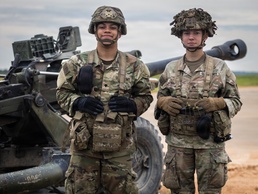
FORT BRAGG, N.C. – To most people outside the U.S. Army field artillery is noise, firepower, and destruction. The thunder of a howitzer firing can shake the ground beneath a soldier’s feet, while the speed and precision required on the gun line can seem almost mechanical.
For soldiers like Spc. Joshua Baizer assigned to 1st Battalion, 319th Airborne Field Artillery Regiment, 3rd Brigade Combat Team, 82nd Airborne Division, the job is about far more than the weapon system itself. Behind every fire mission are soldiers relying on one another through long days, difficult training and high-pressure moments.
“The thing that made me want to choose field artillery is a video I saw from my recruiter,” said Baizer. “He was like, ‘you can be doing this, but it is a lot of work.’ And I said, ‘I don’t mind working.’”
His training experience introduced him to the realities of Army life while teaching the technical skills required for the job, says Baizer. Soldiers learn the components of artillery systems, fire mission procedures and field operations before executing live-fire exercises during Advanced Individual Training.
“One moment that stuck with me is probably the first time I shot live as an assistant gunner because it is a bit different from when you are training,” said Baizer. “When you actually have a live round in your hand, it is like, wow, this is really happening.”
Baizer’s responsibilities as an assistant gunner include helping emplace the weapon system, maintaining equipment and supporting the gunner during fire missions. The work is physically demanding and requires speed, repetition and constant attention to detail.
Baizer said his focus is on making the gunner’s job easier while working as efficiently as possible during missions. His thought process throughout it all is focused on efficiency - recognizing the tools and options available and figuring out the fastest, most effective way to accomplish the task.
Still one of the most important parts of field artillery has nothing to do with the weapon itself, says Baizer.
“I would say it would be the bonds you make with the people in your section,” said Baizer. “It is kind of like a family.”
That sense of connection is something Sgt. Katharine Bello also emphasized. Bello, who originally enlisted as a cavalry scout before transitioning into field artillery, now serves as an ammo team chief responsible for relaying fire missions and ensuring operations are conducted safely.
As a noncommissioned officer, Bello said leadership is built on understanding individual soldiers and adapting to how they learn and respond under pressure.
“Everybody is different. Everyone is going to react differently,” said Bello. “It is important to know your soldiers on a personal level, so you can go about teaching them both professionally and personally.”
Building trust within a section requires more than enforcing standards, says Bello. Soldiers must know their leaders care about them both professionally and personally.
“I think that their well-being, mental and physical health is one of the most important things,” said Bello. “So making sure that my soldiers are cared for and they know I'm there for them, I think that really helps create trust.”
Leadership in field artillery also comes with pressures that junior soldiers may not always see. Bello said leaders often carry the responsibility of maintaining morale and making decisions that directly affect the soldiers under them.
“There is a reason behind everything,” said Bello. “Sometimes when the junior soldiers are struggling through the difficult moments, it becomes the only thing they can focus on.”
Bello also spoke about the challenges she has faced as a female leader in a combat arms environment, saying she often feels pressure to prove herself.
“I just like to stay motivated,” said Bello. “I make sure I know my job. If there's something I don't know, I make sure I learn it, because I feel like I can get tested really easily. And I want to show that I belong here.”
Despite the challenges, both soldiers said the relationships formed in field artillery are what continue to motivate them. Baizer plans to reenlist and hopes to one day mentor younger soldiers the same way his leaders mentored him.
While artillery units are often recognized for their firepower and battlefield capability, soldiers within the formation say the real strength of the profession comes from the people standing beside them on the gun line.
After the smoke clears and the guns fall silent, what remains are the soldiers who worked together to make it happen — trusting one another, pushing through difficult conditions and building bonds that last long after the mission is complete.