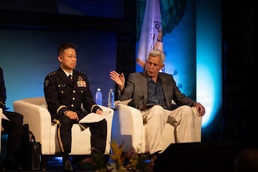
HONOLULU– Senior military leaders and defense experts gathered at the Sheraton Waikiki during the Land Forces Pacific (LANPAC) Symposium and Exposition, May 12, to examine how the Army and its allies are developing agile leaders and combat-ready formations capable of operating in the increasingly complex Indo-Pacific environment. The panel, titled “Education, Training and Experience: Optimizing People and Performance,” focused on preparing forces through modernization, professional development, and multinational collaboration.
The panel was moderated by retired Lt. Gen. John D. Johnson, Vice President of Government Solutions and Strategy at General Motors Defense. Leaders emphasized the importance of leader development, innovation, multinational collaboration, and adaptive training to maintain readiness and deterrence throughout the region.
Panelists included: Maj. Gen. Hope Rampy, commanding general of the U.S. Army Human Resources Command, Maj. Gen. Michelle Link, commanding general of the 75th U.S. Army Reserve Innovation Command, retired Maj. Gen. Suzanne P. Vares-Lum, director of the Daniel K. Inouye Asia-Pacific Center for Security Studies, and Lt. Gen. Shigeo Kaida of the Japan Ground Self-Defense Force Training, Evaluation, Education, Research and Development Command.
Throughout the discussion, panelists emphasized that although technology and warfare continue to evolve rapidly, people remain the military’s greatest advantage. Leaders underscored the need to invest in education, talent management, leadership development, and multinational collaboration to sustain readiness and deterrence in an era defined by artificial intelligence, cyber operations, multi-domain warfare, and large-scale combat operations.
Rampy emphasized the importance of prioritizing Soldiers and leaders as the foundation of all other capabilities within the force.
“You have to have the person first, which is what’s unique about our Army, because that is our number one resource, our number one platform, before you can produce any other capability,” she said.
She also emphasized the importance of developing adaptive leaders capable of solving future operational challenges through critical thinking and professional military education.
“We develop critical thinkers, or we demand critical thinkers so they can be strategic leaders in the future,” she continued.
The panel also explored the growing role of artificial intelligence and innovation in military organizations, while cautioning against allowing technology to replace human judgment and decision-making. Maj. Gen. Link emphasized that AI should remain an enabling tool to enhance operational effectiveness rather than replace human expertise.
“AI should be a tool. AI should not be a replacement for those types of capabilities,” she stated.
She encouraged leaders to think creatively about how emerging technologies and specialized skill sets can be tailored to address operational problems in future operating environments.
“Think about innovation as an enabler, and what that means, and how you customize and tailor a specific skill set to focus, or to support problems at that edge,” she continued.
Panelists repeatedly returned to the importance of multinational interoperability and collaboration throughout the Indo-Pacific region. Vares-Lum highlighted the value of trust, shared understanding, and information sharing among allies and partners as essential components of regional security and readiness.
“This is how we optimize. I would say that our human resources are our most lethal weapon,” Vares-Lum said. “We talk about harder things all the time, but it's the people who make the difference.”
She added that strong partnerships are built through trust and open collaboration.
“We need each other to share ideas, and that comes with trust, to trust each other enough so that we share this information with one another,” she said.
Kaida emphasized the importance of developing personnel capable of adapting to rapidly advancing technologies and operational demands, underscoring that human resource development remains central to national defense capabilities.
“Human resource development is the very essence of defense capability,” Kaida said. “It establishes the most robust foundation.”
He added that modern militaries must continually adapt their education and training systems to prepare personnel for future challenges.
“The key point is that we need to develop personnel capable of keeping pace,” he said.
As the discussion concluded, panelists underscored that optimizing people and performance across the total force requires balancing technological innovation with leadership development, adaptive education, and multinational cooperation. Leaders agreed that future success in the Indo-Pacific will depend not only on modern capabilities but also on the ability to identify, develop, and retain talented people prepared to operate in increasingly complex environments.