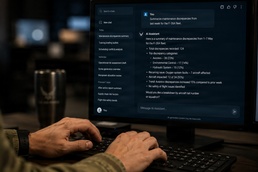
Luke Air Force Base Airmen are shaping how the Air Force integrates artificial intelligence into daily operations, supporting faster decision-making and improved mission effectiveness across the force.
What began with a short-notice tasking quickly evolved into a focused effort as a small team of Airmen set to identify how AI could be applied across the installation, assess limitations, and align emerging tools with mission needs.
“The question was simple: how do we integrate AI into everything, what are the exceptions and what are the constraints?” said U.S. Air Force Master Sgt. Curtis Wright, 944th Operations Group commander’s support staff development and training noncommissioned officer in charge. “I didn’t really know what I was getting into, but once we started digging into it, we realized how big this actually is.”
The effort became the foundation of Luke’s AI Task Force, a team built to explore how artificial intelligence could reshape daily operations, preserve institutional knowledge, and give Airmen more time to focus on the human elements of the mission. With limited time and structure, the team gathered information, reviewed policy, studied use cases, and examined how AI is already being applied across the Department of the Air Force and private industry.
A base-wide survey, which received over170 responses, revealed a consistent theme: while many Airmen recognize AI’s growing importance, many feel uncertain on how to use it effectively and within approved guidelines.
That gap highlighted a broader cultural challenge. Some Airmen are already using AI to draft emails, summarize information, analyze data, and reduce repetitive administrative tasks, while others remain unsure what tools are authorized or how to apply them in a mission context. “Culturally, people are not utilizing these products to their fullest,” Wright said. “Everyone has this capability in their pocket right now. They just have to know how to unlock it.”
Instead of just studying AI, the team decided to put it into practice. Members built tools, analyzed survey data, and explored how emerging technology could support training, administration, and decision-making processes. The results reinforced a key takeaway. AI is not replacing Airmen but reducing the repetitive work that slows them down.
“AI enables the human to do less clicking and more doing,” Wright said. “It enables humans to do human things.” The potential applications span across the force. For public affairs, AI can reduce time spent transcribing interviews and organizing notes. For maintainers, it can support faster troubleshooting. For planners and leaders, it can provide quicker access to data and improve decision-making. The team also explored how AI could help preserve institutional knowledge, capturing experience that is often lost as Airmen transition out of the service and preserving knowledge for the next generation of warfighters.
“Every time a human leaves the Air Force, you’re losing knowledge,” Wright said. “Imagine having something there permanently that can build on that information forever.”
The effort aligns with the installation’s priorities of Airmen, Basics, and Culture covering missing objectives of “who we are, what we do, and how we operate.” The team found AI can help close knowledge gaps, streamline communication, and improve efficiency while also emphasizing the need for clear guidance, training, and leadership support to ensure safe and responsible adoption to achieve air dominance.
Without that foundation, the team noted, Airmen may either avoid AI altogether or turn to unapproved tools that could pose operational security risks.
To address this, the group recommended expanding AI education, identifying trained advocates within units, and improving awareness of approved platforms, with the goal of shifting from informal use to a deliberate, mission-focused approach.
For those involved, the sprint was only a starting point. What began as an email has grown into a larger conversation about how the Air Force can adapt to an increasingly data-driven environment and prepare Airmen for the future of training the world’s greatest fighter pilots and combat-ready Airmen.
“This story matters,” Wright said. “It’s about Luke Air Force Base’s integration into AI and the culture that we have toward that direction.” The next phase of implementation will focus on building AI literacy, reinforcing safe practices, and ensuring adoption translates into lasting interoperable mission execution.