Article written in collaboration with Justin 'Doug' Cook, CCAD manufacturing engineering branch chief.
Corpus Christi Army Depot, Texas— In the high-stakes environment of military aviation, the difference between a mission-ready aircraft and a grounded asset often hinges on a single, specialized part. Corpus Christi Army Depot is changing that narrative using reverse engineering. This approach is essential when spare parts are either unavailable or subject to long lead times from the original equipment manufacturer. The Manufacturing Engineering Branch at CCAD utilized advanced reverse engineering workflows to eliminate a 12-month wait. Although the station 184.75 frame is designed as a permanent airframe component, it was damaged, resulting in a critical readiness gap since this part is typically neither stocked nor anticipated for replacement. While CCAD successfully acquired available peripheral items from the original equipment manufacturers, the frame itself could not be purchased.
"Manufacturing has pushed for 'just-in-time' supply chains, in which you hold little to no extra parts," says Justin Cook, CCAD manufacturing engineering branch chief.
This highlighted a systemic procurement gap, in which original equipment manufacturers prioritize high-volume production and new system deliveries over sustainment. Although initial spare part kits are established based on OEM advice during negotiations, these providers are rarely equipped to support the organic industrial base after fielding. OEMs design their business models for mass production, not for producing singular, non-forecasted parts that are essential for repairing battle-damaged equipment.
Under the Defense Federal Acquisition Regulation Supplement: Procedures, Guidance, and Information on Reverse Engineering (Deviation 2026-O0027) effective February 2026, the right to repair has become a cornerstone of operational readiness for the Department of War. DFARS are the actual laws and regulations that govern how the DoD buys goods and services. If it’s in the DFARS, it is a mandatory rule that must be followed by both the government and the contractor. PGI is a companion resource that contains non-regulatory material. It provides the how-to, internal standard operating procedures, and additional context for the mandatory rules found in the DFARS.
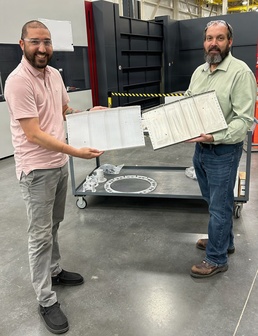
By utilizing in-house reverse engineering and advanced manufacturing, CCAD’s manufacturing engineering branch reduced a potential one-year delay to a two-week turnaround, directly returning a critical aviation asset to the warfighter. This was accomplished through blue light scanning, in which the damaged physical part was scanned to capture precise surface geometry. Then a computer-aided design model was created using scanned data. The digital twin allowed the team to reconstruct the frame’s original specifications. This was followed by the creation of a polycarbonate 3D-printed prototype to verify the form and fit on the aircraft. This bright white model was taken directly to the aircraft's airframe to ensure every mounting point and flange aligned perfectly. The final step included precision machining, which milled the final frame from aerospace-grade stock.
"If adjustments are needed, it is much faster and more cost-effective to tweak the digital computer-aided design file and print another plastic model within 48 hours than it is to manufacture metal parts only to find that further modifications are required," said Jonathan Ferguson, an engineering technician in the manufacturing engineering branch.
The army's organic industrial base is a critical component of the broader defense industrial base, providing readiness, operational capability, and surge capacity. CCAD’s ability to reverse engineer critical components reduces a twelve-month procurement delay to a mere two-week turnaround. This natural ability protects the Department of War from the problems that come with OEM production schedules and supply chain obsolescence. By exercising the right to repair, the organic industrial base ensures fleet readiness and sustained operational superiority.