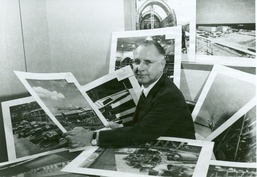
ARNOLD AIR FORCE BASE, Tenn. – Frank Wattendorf wanted to pass the time. During a lengthy flight from Europe to the U.S., the American scientist reflected on recent observations, collected his thoughts and began to write. Wattendorf’s composition, which became known as the Trans-Atlantic Memo, not only provided details of what he had seen, it also included a significant suggestion – the first recommendation of a facility such as the Arnold Engineering Development Center. This suggestion and his subsequent work to help establish the center led to Wattendorf being considered one of the founding fathers of AEDC. Wattendorf was born in Boston, Massachusetts, in May 1906. In 1926, he earned his bachelor’s degree from Harvard University. “As a 20-year-old math major uninterested in teaching but with a keen interest in aerodynamics, he enrolled in the Massachusetts Institute of Technology’s new graduate curriculum in aeronautical engineering,” states Beyond the Speed of Sound, a book detailing the history of AEDC. It was at MIT that Wattendorf met renowned mathematician, physicist and engineer Theodore von Kármán. At the time, von Kármán was considered to be the western world’s leading aerodynamicist and was a visiting lecturer at MIT from the Aachen Institute of Technology in Germany. Von Kármán wrote in his book The Wind and Beyond that after his opening lecture, Wattendorf introduced himself. “He told von Kármán that he was interested in his approach to the subject of aerodynamics,” Beyond the Speed of Sound states. “He said there was a limited opportunity to learn basic aerodynamic theory in America and asked von Kármán to recommend a school abroad.” Von Kármán recommended The University of Göttingen or Aachen, advising Wattendorf that the latter had no American students at that time. “On a lark, Wattendorf went to the head of MIT’s aeronautics department, telling him that he had found the professor he wanted to work for on his master’s thesis,” Beyond the Speed of Sound states. “Although he said it jokingly, the department head agreed.” With that, Wattendorf, accompanied by his mother, traveled to Aachen in 1927 to study with von Kármán. “From that point on, von Kármán considered Wattendorf a member of his family, and the young Wattendorf became his most trusted and reliable assistant,” Beyond the Speed of Sound states. Wattendorf earned his master’s degree in general research from MIT in 1928. According to Josef Singer, past president of the International Council of the Aeronautical Sciences, for two years Wattendorf performed research in Germany on laminar and turbulent boundary layers under von Kármán in Aachen and Professor Ludwig Prandtl in Göttingen. In 1930, Wattendorf accompanied von Kármán to the California Institute of Technology as his assistant. There, Wattendorf was in charge of fluid mechanics research and earned his doctorate from the institute in 1933. He then developed a high-performance pumping station to bring water from the Colorado River to southern California. Wattendorf in 1936 accepted a two-year assignment in China as a professor of aeronautical engineering and director of the Aerodynamics Institute in Beijing, according to Singer. During this period, he designed and supervised construction of China’s first large wind tunnel. In 1939, Wattendorf was appointed civilian director of wind tunnels for the Army Air Forces at Wright Field, in Ohio. There, he and von Kármán designed a 20-foot, 40,000 horsepower wind tunnel and supervised its construction. In 1944, with World War II ongoing, Gen. Henry “Hap” Arnold, commanding general of the Army Air Forces, met von Kármán in New York to discuss national defense needs. The general tasked the scientist with forming an advisory group to provide guidance on the future of direction of aviation research. Wattendorf was appointed a founding member of this assemblage, known as the Scientific Advisory Group. At Arnold’s request, the SAG visited Germany in May 1945 to study testing and research facilities there. While surveying captured German test centers, the group found advanced facilities, rockets, aircraft and jet engines. Wattendorf was among the SAG members who traveled to Germany to examine the facilities there. He intended to remain in Europe to document his findings. However, while in Europe Wattendorf was informed his father had passed away. He boarded a plane to return to the U.S. “I returned on emergency leave aboard a [Materiel Air Transport Service] plane; one of those old bucket seat C-54s,” Wattendorf said. “I was on this plane with nothing to do for a long period of time, so I started putting my thoughts together and just started writing them out. That was on June 19, 1945. I recommended to the Air Force that they consider a new center geared to the coming jet age.” Wattendorf’s report – the Trans-Atlantic Memo – recommended the construction of a center like AEDC. “The present development and future prospects of high-speed jet airplanes are associated with an urgent need for forward-looking advances in research and test facilities for high-speed aerodynamics, propulsion systems and component parts,” Wattendorf’sTrans-Atlantic Memostates. “The scope of the German plans makes it essential that our own plans be certainly not less ambitious in the light of our future security. It is recommended that consideration and study be given the establishment of a new Air Forces research and development center.” The memo was sent to Brig. Gen. Franklin O. Carroll, who was then commander of the engineering division at Wright Field and later served as the first AEDC commander. Carroll used Wattendorf’s writing in a presentation to Gen. Arnold’s Air Staff. In that presentation, Carroll not only highlighted the advancements of German ground testing to underscore deficiencies in American test facilities, he noted that no facilities existed in the U.S. for the testing of turbojet compressors. Carroll also listed the necessary facility for U.S. research and development. He suggested a preliminary study be completed for the establishment of a “new Army Air Force’s Applied Research and Development Center for Fluid Dynamics.” This study and the SAG’s report, entitled Toward New Horizons, were published in December 1945. The latter called for the creation of a research and development facility that could be used for the study and development of jet propulsion, supersonic aircraft and ballistic missiles. TheTrans-Atlantic Memobecame part ofToward New Horizons. Both reports also recommended using captured German test facilities in a new installation to be located near large sources of water and electrical power. The report Carroll had requested, titled “Proposed Air Engineering Development Center,” was presented to the Air Staff in January 1946. That same year, Wattendorf was appointed civilian chairman of the AEDC Planning Group Wattendorf was awarded the Medal of Freedom in 1946 for his overseas surveys and recommendation for a new testing center. Soon after, possible sites for such a center were studied, with Camp Forrest, an Army training base during World War II near Tullahoma, being selected in 1948 as the location for the new Air Engineering Development Center. In October 1949, then-President Harry Truman signed the Unitary Wind Tunnel Plan Act of 1949, clearing the way for construction of the planned center. In March 1950, the Secretary of Defense approved construction of the center, and construction began in the middle of that year. The Air Engineering Development Center was dedicated as the Arnold Engineering Development Center in June 1951. As Wattendorf had suggested in his Trans-Atlantic Memo, captured German equipment was installed and used in the new center. He also provided a list of German scientists qualified to perform research, a number of whom later joined the AEDC staff. From 1950 to 1952, Wattendorf served at the Pentagon as deputy chief scientific adviser of the Air Engineering Development Division, established in early 1950 to oversee the creation of AEDC. The AEDD was redesignated as AEDC the following year. Wattendorf was a founding member of the NATO Advisory Group for Aeronautical Research and Development. According to Singer, Wattendof became the group’s first director, vice chairman in 1963 and Honorary Vice Chairman for Life in 1968. He also helped found the von Kármán Institute for Fluid Dynamics and the International Council for the Aeronautical Sciences. “For nearly 15 years, he assisted in the strategic planning and development of new test facilities and in the improvement of existing facilities,” Beyond the Speed of Sound states. Upon his retirement in 1968, Wattendorf received the U.S. Air Force Medal for Exceptional Civilian Service by the Scientific Advisory Board. “Even so, he continued his activities as a consultant,” Singer wrote. “For his lifelong work in test facilities, he was awarded the Ground Test Facilities Medal of the American Institute of Aeronautics and Astronautics in 1979.” Wattendorf passed away in June 1986 at the age of 80 following a lengthy illness. Wattendor’s death, the late Richard Austin, an AEDC Fellow who began his 35-year AEDC career in 1958, commented on Wattendorf’s “keen sense of mission in furthering the capabilities of the country.” “He had a personal sense of responsibility for what happened here,” Austin said. “That’s one of the hallmarks of a leader. He was the picture of persistence. He involved in the development of AEDC for most of his professional life, from its genesis until his health failed.” The late Maj. Gen. Lee Gossick, who served as AEDC commander from 1964 to 1967, also commented on Wattendorf’s contributions. “Clearly, he was a remarkable man with great foresight,” Gossick said. “He would pull different thinking together for a meaningful recommendation. He was a dedicated, capable, visionary man respected by everybody who knew him.” Alfred Ritter, then-director of technology for the AEDC flight dynamics contractor who knew Wattendorf for 30 years, also offered comment in 1986 following his passing. “There’s a little bit of Frank Wattendorf in every wind tunnel in the United States,” Ritter said. “He was a gentle, sweet guy.” Wattendorf’s widow, Glenn, and their son, Roger, attended ceremonies in 1987 during which the base access highway was named in Wattendorf’s memory. In 2006, Wattendorf was posthumously recognized as an Honorary AEDC Fellow for his contributions to the center.
This is the 15th in a series of articles highlighting the history of Arnold Engineering Development Complex during its first 75 years. Additional articles will be published throughout 2026 to commemorate the anniversary of AEDC.